Tuesday, February 1, 2022

The Life of Vultures


Turkey Vulture (Cathartes aura) soaring. The underside of the
 primary and secondary feathers of Turkey Vulture wings are silver. 
Palm Beach County, Florida.

Vultures get a bad rap.  Their dark feathers and naked heads are not very appealing.  Their diet of carrion may even be appalling.  In western cultures vultures are viewed as ill omens, representing death, but ancient Egyptians held and Hindus still hold vultures to be sacred.  Vultures have a fascinating biology with adaptations for eating dead animals. They are masters of soaring.  Vultures can catch thermals and ride to high altitudes with little expenditure of energy.  From these great heights they scan the earth for their next meal.  Sometimes large number of vultures can be seen soaring together.  A group of soaring vultures is called a kettle.  The collective noun for a group of feeding vultures is, appropriately, a wake. 


A kettle of Turkey Vultures rising on a thermal.
Horry County, South Carolina. 

Black Vulture (Coragyps atratus) in flight.
The feathers at the tips of the wings are silver.
Mecklenburg County, North Carolina.  

Two species of vultures live in eastern North America, the Turkey Vulture (Cathartes aura) and the Black Vulture (Coragyps atratus). Vultures are raptors related to hawks and eagles.  Like hawks and eagles, vultures have hooked beaks for tearing their food. Unlike hawks and eagles that have powerful toes and talons for capturing and killing prey, vultures have weak toes with blunt talons because their prey is already dead. Both species of eastern North American vulture lack feathers on their heads and necks.  The bare head makes it easier to keep clean after feeding inside a dead animal.  Both Black and Turkey Vultures have perforate nostrils.  When viewed from the side you can see through the nostril.  

Turkey Vulture showing its perforate nostril. This species
of vulture has a highly developed sense of smell. 
Horry County, South Carolina. 

Turkey Vultures are large birds, with a wingspan of about 6 feet.  At a distance, Turkey Vultures appear black, but closeup they are dark brown.  The flight feathers of the wings are sliver beneath and the contrast with the rest of the wing is striking.   Turkey Vultures soar with their wings held up in a shallow vee, a dihedral, and rarely flap.  Turkey Vultures have naked, red heads. This gives the Turkey Vulture its name because it resembles the head of the Wild Turkey (Meleagris gallopavo).  Unlike most birds, Turkey Vultures have a well-developed sense of smell.  They can detect a rotting animal by smell then zero in on their meal visually.  Natural gas pipeline companies use the Turkey Vulture’s sense of smell to help detect leaks in their lines.  Natural gas itself has no odor so the refiners add an odoriferous compound, ethyl-mercaptan, so the users of gas appliances can tell if there is a leak.  This chemical is also emitted by a rotting animal and a leak in a natural gas pipeline attracts Turkey Vultures.  A kettle of vultures above a pipeline can alert the gas company of a leak.

Turkey Vulture perched. Although Turkey Vultures
appear black in flight they are really dark brown. 
Palm Beach County, Florida. 

A pair of Turkey Vultures flying in formation. 
Vultures often congregate in large groups. 
Mecklenburg County, North Carolina. 

Black Vultures are slightly smaller than Turkey Vultures with shorter wings and tails.  Black Vultures have less surface area for soaring, so they must flap more often than Turkey Vultures to stay aloft.  Black Vultures have black feathers and bare black heads.  They also have a patch of silver feathers near the end of their wings so are easy to distinguish from Turkey Vultures in flight. Black Vultures do not have the finely developed sense of smell of Turkey Vultures but what Black Vultures lack in sense of smell they make up for in aggressiveness.  Black Vultures often follow Turkey Vultures and displace them on a dead animal.  

Black Vulture in flight. 
Palm Beach County, Florida.

Black Vulture on the ground. 
Marion County, Florida. 

Vultures play an essential role in ecosystems.  They quickly dispose of carcasses and prevent the spread of disease. They can safely eat dead and even diseased animals because their digestive systems inactivate pathogenic microorganisms. Vultures quickly recycle nutrients in the environment and reduce greenhouse emissions.  A study of Turkey and Black Vultures in central Florida showed they can completely skeletonize a pig carcass in eight hours. 

Black Vultures feeding on carrion.
Rowan County, North Carolina. 

While American vultures are experiencing a population increase, the vulture populations in India are crashing.  The number of Indian vultures has decreased by 90% in the last 40 years.  This population decline was caused by the use of an anti-inflammatory drug as a veterinary treatment for domestic animals.  While this medicine was beneficial to the domestic animals, it was lethal to vultures that would scavenge the treated animals. The decline in vulture population has caused social disruptions too.  The Parsis are a distinct ethnic group in India and they practice Zoroastrianism, a religion that originated in ancient Persia.  The traditional funeral practice of Indian Parsis is to place their dead on stone towers, the Towers of Silence, where vultures consume the deceased.  With the decline in vulture numbers the Parsis have modified the Towers of Silence to include solar concentrators to heat the remains and dry them as they are eaten by smaller scavengers like crows and kites.  While vultures could remove the flesh from a body in a day, the process now may take weeks.  Another side effect of the loss of vultures in India is an increase in other scavengers like feral dogs and rats.  These animals can transmit rabies and plague and are a public health hazard.  

A Black Vulture warily watching a group of humans.
Mecklenburg County, North Carolina. 

Despite their distasteful habits, vultures are interesting creatures that provide essential ecosystem services.  They are large birds and they are magnificent flyers that can inspire the viewer, at least from a distance.   


Saturday, January 15, 2022

Spirals


Ox-eye Daisy (Leucanthemum vulgare). This flowering head is made of 
           hundreds of small flowers.  The disc flowers in the center 
are arranged in Fibonacci numbers of spirals. 
Rowan County, North Carolina. 

Spirals abound in nature. They appear in spiral galaxies and DNA molecules, pine cones and snail shells, vines and sheep horns.  Biological spirals are all related to growth and have a deep mathematical basis.


Logarithmic spiral.
https://simple.wikipedia.org/wiki/Logarithmic_spiral


White-lipped Globe Snail (Mesodon thyroidus).  This snail's
shell is in the form of a logarithmic spiral.
Rowan County, North Carolina. 

One spiral that appears again and again is the logarithmic spiral.  This spiral starts at a central point and increases in diameter with the distance between turnings of the spiral increasing exponentially.  Snail shells are classic examples of logarithmic spirals.   The oldest part of the shell is at the center of the spiral and as the snail grows it increases in size and adds more shell to spiral.  Another logarithmic spiral occurs in the horns of wild sheep.  Dall Sheep (Ovis dalli) are white sheep of the subarctic mountains of North America.  The rams have large logarithmic spiral horns they use in batter each other in the mating season.  The winners of these battles get to mate with the ewes. The oldest part of the horn is the tip and new material is added at the base where the horn contacts the head of the sheep. 

Dall Sheep (Ovis dalli) ram with
 its logarithmic spiral horns. 
Chugach National Forest, Alaska. 

A mathematical concept related to the logarithmic spiral is the Fibonacci sequence.  Each number of the Fibonacci sequence is produced by adding the value of the two previous number.  The start of the Fibonacci sequence is 1, 1, 2, 3, 5, 8, 13…


Common Sunflower (Helianthus annuus).  The flowers are
arranged in Fibonacci numbers of spirals.
Rowan County, North Carolina. 

The flowering head of sunflowers and daisies and are made up of hundreds of closely packed flowers and later fruits.  These flowering heads show many logarithmic spirals.  The number of spirals in the head is one of the Fibonacci sequence of numbers.  There are spirals that run both clockwise and counter-clockwise.   

Pine cones also show the Fibonacci sequence in the rows of scales.  These logarithmic spirals allow efficient close packing of flowers and scales. 

Shortleaf Pine (Pinus echinata) cone.  The scales of the cone are
                                                 arranged in clockwise and counter-clockwise spirals.  This cone has 8                                                       counter-clockwise spirals, a Fibonacci number. 
Rowan County, North Carolina. 

The same Shortleaf Pine cone as above showing 13 clockwise
spirals.  13 is another Fibonacci number. 
Rowan County, North Carolina. 

Leaf arrangement in many plants also exhibit an aspect of the Fibonacci sequence.  The ratio of Fibonacci numbers approaches the golden ratio, 1:1.618... This ratio appears in many natural objects, in art and in architecture.  This ratio, designated phi (φ), is an irrational number and was used by the ancient Greeks in the design of the Parthenon, by Leonardo da Vinci in the composition of the Mona Lisa and in many other instances by artists both ancient and modern.  The Fibonacci spacing allows the plant to efficiently collect light for photosynthesis by spacing each successive leaf at an angle of about 137o.  This angle is derived from φ and is called the golden angle.    

Haircap Moss (Polytrichum strictum).  The leaves are arranged at the
golden angle to allow for optimal photosynthesis. 
Denali State Park, Alaska. 

Agave sp. showing the golden angle arrangement of leaves. 
Biltmore House, Buncombe County, North Carolina. 

Some spirals in nature do not increase in diameter but take the form of a helix.  The tendrils of Passionflower (Passiflora sp.) allow this herbaceous vine to ramble over other plants.  A number of woody vines like Japanese Honeysuckle (Lonicera japonica) and Trumpet Creeper (Campsis radicans) grow in a helical pattern on a supporting tree.  The vine attaches to a trunk and spirals up, seeking more light higher in the tree.  As the vine wraps around the trunk it applies force to the tree and distorts its growth into a complimentary helical form.  Later, the vine may die and leave behind a helical tree trunk that is a favorite of walking stick makers. 

Yellow Passionflower (Passiflora lutea) with a helical tendril.
Rowan County, North Carolina. 

A tree trunk with a helical vine wrapped in a spiral.
Georgetown County, South Carolina. 

Helical tree trunk after the spiral vine has died.
Rowan County, North Carolina. 

Spirals are all examples of evolutionary solutions to problems faced by living things. Spirals solve problems of growth, of optimal space filling and of energy collection. These mathematical solutions are achieved by organisms that cannot think. I find it interesting these mathematical adaptations are also so aesthetically pleasing. 


Saturday, January 1, 2022

Pipsissewa


Pipsissewa (Chimaphila  maculata) flowering
in summer.  Rowan County, North Carolina. 

In mid-winter my thoughts turn to Pipsissewa.  Pipsissewa is a small evergreen herb that grows in the understory of eastern North American forests.  Pipsissewa is an interesting name because it is at the center of an etymological controversy.  One source says Pipsissewa is derived from the Cree indigenous language and means “to break into pieces”.  Pipsissewa has many medicinal uses including as a treatment for kidney stones, thus the breaking into pieces.  Another explanation says Pipsissewa comes from the Eastern Abnaki tribe and means, “flower of the woods”.  Other common names for this plant are more descriptive.  It is also called Spotted Wintergreen, which is odd because it is not spotted, but it is green in winter.  Another name is Striped Wintergreen, which is quite accurate.  The scientific name of Pipsissewa is Chimaphila maculata.  Chimaphila is from the Greek meaning winter loving and maculata is Latin for mottled (not striped).  

Pipsissewa leaves in winter.
Rowan County, North Carolina. 

Pipsissewa is classified in the Ericaceae, the same family as Rhododendron and Blueberry. The plants stand a few inches tall and the bright green leaves are marked with white veins.  Pipsissewa prefers to grow in dry, acidic soil beneath trees.  I think of Pipsissewa as an herb but it is technically a sub-shrub. It has a woody underground stem and with its short stature Pipsissewa qualifies for the odd category of sub-shrub.  In spring, each plant produces one to a few white, nodding flowers.  These flowers are pollinated by bees and as the fruit develops it rotates to face upward.  When mature, the fruit is a brown, five-part capsule that contain around a thousand of tiny seeds. 

Pipsissewa with flower buds.
Rowan County, North Carolina. 

Closeup of Pipsissewa flower buds.
Rowan County, North Carolina. 

Pipsissewa has many traditional medicinal uses beyond treating kidney stones.  It has antibacterial activity and has been used to treat urinary tract infections.  It can be applied to the skin as a treatment for ringworm and ulcers.  The many biologically active compounds produced by Pipsissewa may also account for another common name, Rat Bane.  These same compounds are probably why deer avoid Pipsissewa even as they are devastating other woodland plants.  

Dry Pipsissewa capsules in winter.
Rowan County, North Carolina. 

Closeup of Pipsissewa capsule.
Rowan County, North Carolina. 

A second species of Pipsissewa, Chimaphila umbellata, grows in the southeast but is rarer than C. maculata.  I like Pipsissewas because they brighten the summer with their flowers and are a splash of green even in winter.

Thursday, December 16, 2021

Bird Portraits


Tricolored Heron (Egretta tricolor). Green Cay Wetlands.
Palm Beach County, Florida 

Birds are hard to photograph.  Many are small, actively moving and distant.  But sometimes, in some places, you can get close looks and even closeup photos, bird portraits.  

Great Egret (Ardea alba). Green Cay Wetlands.
Palm Beach County, Florida.

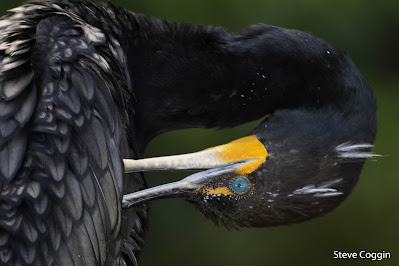
The most striking feature in bird portraits is usually the eyes.  Different species have a different look to their eyes.  Herons and egrets have keen, piercing eyes.  They are eyes of vicious predators that weigh only a few pounds.  Pigeons have the eyes of prey, constantly looking for their predators that can come from any direction.  

White Ibis (Eudocimus albus). Wakodahatchee Wetlands. 
Palm Beach County, Florida. 

Rock Pigeon (Columba livia). Green Cay Wetlands.
Palm Beach County, Florida. 

Boat-tailed Grackle (Quiscalus major). Wakodahatchee Wetlands.
Palm Beach County, Florida. 

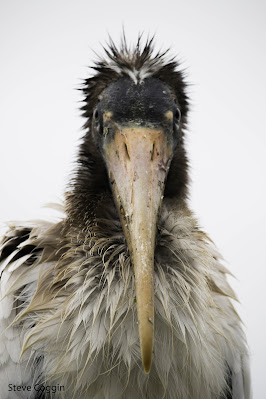
Another feature that stands out in portraits of birds is the beak.  The beak is made of the protein keratin, the same structural element in hair, hooves and claws.  Keratin allows the beak to be strong and light.  Beaks take on some of the functions of teeth in other animals.  Of course, the birds of today do not have teeth.  These were lost in evolution to cut down of weight and allow flight. Nostrils are located on the beak and are mostly is used for breathing.  The sense of smell is greatly reduced in birds. They lost the olfactory lobes of the brain in another weight saving adaption for flight.  

Double-crested Cormorant (Nanopterum auritum) Wakodahatchee Wetlands.
Palm Beach County, Florida. 

Double-crested Cormorant. Green Cay Wetlands.
Palm Beach, Florida. 

Great Egret. Green Cay Wetlands.
Palm Beach County, Florida. 

Tricolored Heron. Green Cay Wetlands.
Palm Beach County, Florida. 


Juvenile Wood Stork (Mycteria americana). Wakodahatchee Wetlands.
Palm Beach County, Florida.  

Limpkin (Aramus guarauna). Green Cay Wetlands.
Palm Beach County, Florida. 

Most mammals have obvious external ears. But even in a closeup view of a bird head the ears are not visible.  Birds have hidden ears, covered by feathers.  Despite the feather covering, birds have an excellent sense of hearing. They use this fine-tuned sense to communicate with each other, and to detect predators or prey.   

American Coot (Fulica americana). Green Cay Wetlands.
Palm Beach County, Florida. 

Tricolored Heron. Wakodahatchee Wetlands.
Palm Beach County, Florida. 

Great Blue Heron (Ardea herodias). Paynes Prairie.
Alachua County, Florida. 

Feathers are the defining feature of birds.  They are made of keratin, the same protein the makes up the beak.  Feathers cover most of the bird and have many functions including flight, insulation and mating display.  The color of feathers ranges from deepest black to pure white and all colors in between.  Sometimes the feathers are iridescent and flash with color as the angle of light changes. Some birds have a cryptic feather pattern that acts as perfect camouflage.  

Anhinga (Anhinga anhinga). Green Cay Wetlands.
Palm Beach County, Florida. 

Black-bellied Whistling Ducks (Dendrocygna autumnalis). Green Cay Wetlands.
Palm Beach County, Florida. 

Green Heron (Butorides virescens). Wakodahatchee Wetlands.
Palm Beach County, Florida. 

Cattle Egret (Bubulcus ibis). Wakodahatchee Wetlands.
Palm Beach County, Florida. 

Juvenile Cattle Egret. Wakodahatchee Wetlands.
Palm Beach County, Florida. 

American Bittern (Botaurus lentiginosus). Green Cay Wetlands.
Palm Beach County, Florida. 

These images were made at refuges in Florida where people and birds tolerate each other.  This allows  close interactions that do not stress the birds.  Birds are so much like us, and so different.  Getting a chance to see birds at close range is real gift.  

Pied-billed Grebe (Podilymbus podiceps). Green Cay Wetlands.
Palm Beach County, Florida. 


Wednesday, December 1, 2021

Achlorophyllous Plants

Indian Pipes (Monotropa uniflora). This cluster of achlorophyllous plants
is pushing through the leaves in early summer.  
Rowan County, North Carolina. 

When I think of plants I think green.  But there are some plants that never turn green because they do not make chlorophyll.  They are achlorophyllous.  Achlorophyllous plants come in a wide range of colors from white, to yellow, to pink but they all share a common feature.  Since they do not make chlorophyll they cannot carry out photosynthesis.  These plants have to get their organic nutrients from another source.  

How do these plants get their nutrients?  It was long thought that some achlorophyllous plants were saprotrophs, absorbing their nutrients from decaying organic material in the soil. It is now known they actually get nutrients from fungi.  The fungi are in a symbiotic relationship with a photosynthetic plant, often a tree.  The tree provides organic nutrients to the fungus and the fungus transfers water and inorganic nutrients to the tree so both benefit. Our achlorophyllous plant parasitizes the fungus for nutrients without providing a benefit to the fungus.  This type of nutrition is called mycohetertropy.  But not all achlorophyllous plants are mycoheterotrophs.  Some directly parasitize a photosynthetic plant by penetrating the root or stem and stealing nutrients.

Indian Pipes turning black after flowering.
Blue Ridge Parkway, Watauga County, North Carolina. 

Indian Pipe (Monotropa uniflora) is a mycoheterotroph in the Ericaceae, the same family as Azalea and Blueberry.  This widespread plant is found in North America, South America and Asia. Another common name for Monotropa uniflora is Ghost Plant because the whole plant is ghostly white.  Indian Pipe often grows under beech trees where its fungal host is associated with the beech. The Indian Pipe plant is 4-8 inches tall with a nodding flower and small leaves. Highly reduced leaves are a feature of many achlorophyllous plants because they do not carry out photosynthesis and do not need a large leaf area.  After flowering the Indian Pipe stem and leaves turn black. 

Dodder (Cuscuta sp.) in flower.  The host plant is Muscadine (Vitis sp.)
Jackson Park, Henderson County, North Carolina. 

A truly bizarre parasitic achlorophyllous plant is Dodder (Cuscuta sp). Dodder is in the same family as Morning Glory (Convolvulus sp.) and has thin yellow stems that drape over its host plant like colorful spaghetti.  The leaves of Dodder are reduced to minute scales on the stem.  There are more than 100 species of Dodder with the highest diversity in the tropics.  Dodder in North Carolina is represented by 8-10 species and they all are annuals growing from seed each spring.  The Dodder seedling locates its host by detecting volatile organic molecules its host releases. The seedling then grows over the surface of the host and invades the stem to extract nutrients.  Dodder parasitizes a number of crops and causes significant economic damage.  Dodder has a number of other interesting common names like; Witch’s Hair, Love Vine and Devil’s Guts. 

Dodder growing on Sand Live Oak (Quercus geminata).
Palm Beach County, Florida. 

A large stand of Dodder draping over Sand Live Oak.
Palm Beach County, Florida. 

Beechdrops (Epiphagus virginiana) is classified in the Family Orobanchaceae and is a parasite on American Beech (Fagus grandifolia).  The genus for Beechdrops is from the Greek “epi” meaning on and the scientific name of American Beech, Fagus. The specific name virginiana came from where the first specimen was described but this plant is found throughout eastern North America.  Beechdrops directly parasitizes the roots of American Beech and extracts nutrients. Beechdrops have a brown stem sporting tiny scale-like leaves. Beechdrops make light purple flowers that appear in summer. 


Beechdrops in flower.
Rowan County, North Carolina. 

Conopholis americana, Cancer Root, is another member of the Orobanchaceae.  Like Beechdrops, Cancer Root directly parasitizes trees, in this case Oaks (Quercus sp.).  Cancer Root has medical properties and can be made into an astringent tea used to treat bleeding and menopausal symptoms.  Ironically, this plant is not used to treat cancer.  An obsolete, racist common name for this plant is Squaw Root.  Another common name for this parasite is Bear Corn because it is reported to be a favorite food of bears awakening from hibernation.   

Cancer Root (Conopholis americana).
Blue Ridge Parkway, Watauga County, North Carolina.
 

Corallorhiza, is a genus of mycoheterotrophic orchid with 11 species in North America.  The common name Coral Root comes from its branched, underground stem that resembles coral.  Corallorhiza has greatly reduced leaves like many of the achlorophyllous plants and a reddish-brown stem.  Wasp pollinated purple flowers are borne on the pink stem.  

Western Coral Root (Corallorhiza mertensiana).
Crater Lake National Park, Oregon.  

Closeup of Western Coral Root with flower buds
that are about to open.
Crater Lake National Park, Oregon. 

Flower of Western Coral Root.
Crater Lake National Park, Oregon. 

I think achlorophyllous plants are interesting because they have taken a different path from other plants.  Despite their lack of chlorophyll, they are all closely related to plants which can do photosynthesis.  Achlorophyllous plants have highly reduced leaves and their chloroplasts have lost many of the genes for photosynthesis.  Achlorophyllous plants are a fascinating slice of life’s rich diversity.