Friday, April 1, 2022

Light and Water


A small section of a rainbow showing the
spectrum of visible light.  Otto Lake, Alaska.

The physics is well known, even simple. Reflection, refraction, absorption.  But the interaction between water and light produces spectacular effects. 

A wine glass filled with water.  The water
appears colorless. 

Look at a glass of water. It appears clear, colorless. But if you get a long enough column of water it takes on a blue hue.  Look down into a deep lake or the ocean and the blue color jumps out at you. Water absorbs the red wavelengths of light leaving the blue light and giving it the color.  

The Atlantic Ocean off Hatteras, North Carolina.
The ocean here is deep and appears deep blue because the red wavelengths
of light are absorbed by the water.  

Crater Lake fills the caldera of an ancient volcano.
The lake is nearly 2000 feet deep and is deep blue. 
Crater Lake National Park, Oregon. 

In addition to absorption, reflection also contributes to the color of water.  Reflection from the sky can change the appearance of water.  A cloudy, gray sky will be reflected from the surface and give a completely different look to water.    

Gray sky reflected on the surface of
Kachemak Bay, Alaska.

Sunrise and sunset reflected in water can produce dramatic colors.  As the sun moves, the reflections on water change with great speed.  

A beautiful sunrise reflected in Murrells Inlet,
Georgetown County, South Carolina. 

Pink morning light on Lake Norman, Mecklenburg County, North Carolina. 


Warm sunset reflected from the surface of 
Lake Norman, Mecklenburg County, North Carolina. 

Reflections of plants growing in water and animals standing in still water gives a mirror-like effect, and makes a nearly exact copy of the original. 

Snowy Egret (Egretta thula) and its reflection.
Huntington Beach State Park, South Carolina. 

Water plants reflected in still water.
Green Cay Wetlands, Palm Beach County, Florida. 

Black-necked Stilt (Himantopus mexicana) reflected
in Radicha Creek, Kleberg County, Texas. 

Blue-winged Teal (Anas discolor) and reflection.
Wakodahatchee Wetlands, Palm Beach County, Florida. 

Some of the most amazing interactions of light and water take place in the sky.  Rainbows are made by refraction of light through tiny water drops that act as prisms. The droplets divide the white light of the sun into its constituent wavelengths of red, orange, yellow, green, blue, indigo and violet.  This is the spectrum of visible light.  Many of us learned the famous mnemonic, ROYGBIV, to keep the order of the rainbow colors straight.  In a rainbow, red is on the outside of the arc and violet on the inside.  

Rainbow at Otto Lake, Alaska. 

We view rainbows with our backs to the sun. Each color, each wavelength, is refracted a different amount causing the rainbow to form.  A rainbow is really circular, but often part of the circle is below the horizon so we see it as an arc. The angle of refraction of light in a rainbow is about 42o so the rainbow fills an 84o section of the sky.  

Sunbow and sundogs.
Sax-Zim Bog, St. Louis County, Minnesota. 
Photo courtesy of Ms. Judy Walker. 

Another refraction-based phenomenon is a sunbow or halo.  A sunbow is a spectrum in a circle that surrounds the sun.  Sunbows are caused by refraction of sunlight through ice crystals and the angle of refraction is 22o.  This refraction produces a halo that fills 44o of sky, about half that of a rainbow.  Since sunbows have a smaller angle than rainbows you are much more likely to see the entire circle of a sunbow. The order of colors in a sunbow is the opposite of a rainbow with violet on the outside and red on the inside.  

Sundog. Huntington Beach State Park, South Carolina. 

Sundogs are related to sunbows and their technical name is perihelial arcs.  They are another refraction effect caused by ice crystals and are found at 22o to the right and left of the sun.  Sundogs sometimes appear isolated and other times are associated with sunbows.  There are sundogs in the photo of the sunbow above. 

Interactions between light and water have significant cultural meaning around the world. In ancient Greek mythology, Narcissus fell in love with his own reflection in a pool of water and stared at it until he died.  This story gives us the term narcissism.  Rainbows are considered deities in diverse cultures.  Many Australian Aboriginal groups revere the Rainbow Serpent and in ancient Greece, Iris was the rainbow goddess.  Hawaii is renowned for its rainbows and there the goddess Anuenue took the form of a rainbow and served as a messenger for her immortal brothers.  In the Genesis, God sent the rainbow as a sign to Noah that the world would not destroyed again by flood.  Ancient Norse mythology has a Rainbow Bridge from Asgard to Earth.  In our time, the rainbow flag has become the banner for gay pride. On a lighter note, Ireland gave us the story of a pot of gold at the end of the rainbow, guarded by a leprechaun. In the Wizard of Oz, Dorothy longs to go over the rainbow from a monochrome Kansas.  Science and culture give us different views of water/light interactions.  This is a measure of the impact these phenomena have on all people. 

Sunset reflected in Lake Norman,
Mecklenburg County, North Carolina. 

Tuesday, March 15, 2022

Wayward Birds


A vagrant female Calliope Hummingbird (Selasphorus calliope)
in Charlotte, North Carolina. 

Some birds spend their whole lives in one area.  Others undertake long distance migrations that cross continents and oceans.  But sometimes birds wander and end up where they are not supposed to be.  These out of place birds are called vagrants. The term vagrant conjures up images of homeless people who wander and just scrape by.  Vagrancy in birds is probably much less dire. In some cases vagrancy establishes new populations and even species. 

There are several explanations for bird vagrancy.  Some birds are blown out of their normal range by storms.  Hurricanes are famous for bringing sea birds far inland.  Migratory birds will sometimes overshoot their destination and end up further north or further south than other members of their species.  Other vagrants seem to have a faulty navigation system and migrate in the wrong direction.  Still others just seem to wander.  Some seem to have taken a page from the American naturalist, Bugs Bunny, who famously said, “I know I should have taken a left turn at Albuquerque”.

In December 2019, we saw a Heermann’s Gull (Larus heermanni) on the beach at Lake Worth, Florida.  This large gull normally lives on the west coast of North American from British Columbia in the north to Baja and the coast of Mexico in the south.  Adult Heermann’s Gulls are gray with a white head, while juvenile birds are all gray.  These handsome gulls are rare but regular visitors to the east coast. 

A juvenile Heermann's Gulls (Larus heermanni)
on the beach.  Lake Worth, Florida. 

Another gull that crosses the continent with some regularity is the Slaty-backed Gull (Larus schistisagus).   This large gull breeds along the Pacific coast of East Asia, from Japan to Russia.  Slaty-backed Gulls are regular visitors to Alaska but also wander down the Pacific coast of North America, across to the Great Lakes and some even reach the shores of the Atlantic.  We tracked down an adult Slaty-backed Gull at the Horry County Landfill near Myrtle Beach, South Carolina in January 2022.  There were over 10,000 gulls at the landfill but we managed to find this rare one without much trouble thanks to good advice from the landfill workers and other birders.  

An adult Slaty-backed Gull (Larus schistisagus
at the Horry County Landfill, South Carolina. 

The Slaty-backed Gull ignored all the landfill activity
 around it and enjoyed the rich pickings.
Horry County Landfill, South Carolina. 

Western hummingbirds sometimes wander east, usually during the winter. The Calliope Hummingbird (Selasphorus calliope) is the smallest native hummingbird in the United States and breeds in the western mountains.  It then undertakes a long migration to central Mexico for the winter.   But some birds make that wrong turn and end up in New England in the fall and some winter in the southeast.  We saw a Calliope Hummingbird coming to a feeder in Charlotte, North Carolina in December 2017.

Female Calliope Hummingbird.  This picture caught the bird
defecating.  Many birds lighten their load before taking flight.
Charlotte, North Carolina. 

Rufous Hummingbirds (Selasphorus rufus) are probably the most common of the western hummingbirds that come east.  They nest in the northern Rocky Mountains and migrate to Mexico.  But many winter across the central and eastern United States, some even reach Florida.  Male Rufous Hummingbirds have an iridescent orange throat, reddish brown tail, back and flanks.  Females also show the rufous color but not as vividly as the males.  

A female Rufous Hummingbird  (Selasphorus rufus) was visiting a hummingbird feeder
at Riverbend Park in Catawba County, North Carolina in December 2021. 
Rufous Hummingbirds regularly winter in this park.

Bullock’s Orioles (Icterus bullockii) are striking orange, black and white birds that are normally found west of the Great Plains.  While most of their species migrate to Mexico some head east.  The Bullock’s Orioles that winter in eastern North America often come to feeders that they may share with Baltimore Orioles (Icterus galbula).  In the 1970s and 1980s lumping bird species was in scientific fashion.  At that time the Bullock’s and Baltimore Orioles were combined into one species, the Northern Oriole.  New genetic research in the 1990s caused them to be separated again.  North Carolina hosts Bullock’s Orioles each winter and they are a welcome visitors.  

A juvenile male Bullock's Oriole (Icterus bullockii) visiting a feeder in January 2018.
Charlotte, North Carolina. 

Another brilliant western bird that sometimes winters in the east is the Western Tanager (Piranga ludoviciana).  These birds are yellow, black and white and the adult males sport red on their heads.  The eastern vagrants often hang around feeders eating suet and seeds. 
 
This male Western Tanager (Piranga ludoviciana) stayed during the winter
of 2018-2019 in Salisbury, North Carolina 

Some birds drift north from their tropical homes and Florida hosts many of them.  In the winter of 2020-2021 a number of vagrants flew up to the Keys and so we went to see them.  We found a Red-legged Thrush (Turdus plumbeus) at the Key West Tropical Forest and Botanical Garden perched in a fig tree.  This placid bird showed no concern about the many birders who stood under its tree and gawked.  The Red-legged Thrush is a robin-sized bird with a dark gray head, body, wings and tail, an orange belly and bright red feet and eye ring.  This handsome bird’s normal range is the West Indies from Puerto Rico to Cuba and north to the Bahamas.  

A Red-legged Thrush (Turdus plumbeus) at the 
Key West Tropical Forest and Botanical Garden, Florida.

The second tropical visitor we saw on that trip to the Keys was a Cuban Pewee (Contopus caribaeus).  This small flycatcher is native to Cuba (naturally) and the Bahamas but one spent the winter at the National Key Deer Refuge on Big Pine Key.  The Cuban Pewee resembles the Eastern Wood Pewee (Contopus virens) that breeds in North American but the Cuban species has a crescent-shaped white mark, a teardrop, behind the eye.   

Cuban Pewee (Contopus caribaeus) at the Key Deer Refuge, Florida. 

Studies suggest that many vagrants do not survive, but vagrancy can play in important role in dispersing birds and possibly establishing new populations.  Cattle Egrets (Bubulcus ibis) are native to Africa but flew across the Atlantic to colonize South America in 1870s.  Then they spread to North America where they established breeding populations by the 1950s.  In the 1960s these long-range wanderers reached the Galapagos Islands off South America.  The famed Galapagos Finches (Geospizinae), found on those same islands, evolved from vagrant American finches that were blown to those volcanic dots in the Pacific. 

Cattle Egrets (Bubulcus ibis) are notorious vagrants 
and have spread from Africa to South
and North America in the last 135 years.
Wakodahatchee Wetlands, Palm Beach County, Florida.  

Climate change may increase the number of vagrants. Vagrancy could be the first sign of an expanding range for species. These wayward birds do wander but whatever their fate, they can delight the birders who see them.

Tuesday, March 1, 2022

Jack-in-the-Pulpit


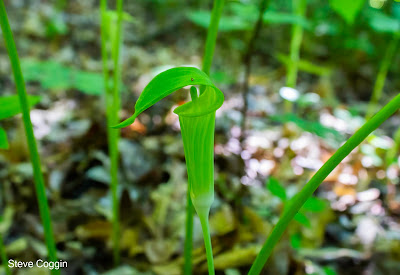
Jack-in-the-Pulpit (Arisaema triphyllum) in flower.
Rowan County, North Carolina. 

Preacher Jack stands in his green chapel, sermonizing in spring and in fall is transformed. 

Jack-in-the Pulpit (Arisaema triphyullum) is a perennial spring wildflower that grows in eastern North America.  Arisaema triphyllum is in the Araceae, the Arum family.  This family has many well know plants including the New World rainforest/houseplant Philodendron hederaceum.  Titan Arum (Amorphophallus titanum) is another plant in this family. It grows in Sumatra and produces the largest flower in the world. Titan Arum is also called the corpse plant because it releases the odor of rotting flesh to attract its pollinators. Skunk Cabbage (Symplocarpus foetidus), another Araceae, grows in North American and as its name suggest also produces a strong smell to attract pollinating insects. 


Jack-in-the-Pulpit with flower and trifoliate leaves.
Rowan County, North Carolina. 

Jack-in-the-Pulpit has three-part, compound leaves and in North Carolina flowers in March and April.  And oh, what a flower Jack makes. This complicated flower consists of a spathe (the pulpit) which is a sheath that wraps around and makes a hood over the spadix.  The spadix (Jack) is a cylinder in the center of the spathe and contains hundreds of tiny, separate male and female flowers.  The spadix produces an odor that smells like fungus to attract the pollinators, fungus gnats.  The gnats follow the smell into the spathe where they collect pollen to take to the next flower. 


Jack-in-the-Pulpit flower with spathe and spadix. 
Rowan County, North Carolina. 

Most of the Jack-in-the-Pulpit that grows in our area make a yellow-green spathe and spadix.  There are more colorful ones out there with maroon stripes on the spathe and a purple spadix.  

Jack-in-the-Pulpit in October
with its bright red fruit.
Rowan County, North Carolina. 
 

After pollination, the fertilized female flowers in the spadix develop into fruits. By fall, Jack-in-the-Pulpit bears red berries.  These fruits are eaten by birds and small mammals who disperse the seeds in their droppings. 

Jack-in-the-Pulpit is a long-lived plant with some specimens surviving for over 20 years.  They grow in rich woods and floodplain forests.  Jack-in-the-Pulpits are protected from herbivores because they contain the toxin calcium oxalate.  Calcium oxalate crystals are pointed and cause abrasions when eaten and the chemical itself induces a burning sensation. 


Jack-in-the-Pulpit flower.
Rowan County, North Carolina. 

Jack-in-the-Pulpit will emerge soon, preaching his sermon in the woods. 

Tuesday, February 15, 2022

Winter Birding in Minnesota


A Long-eared Owl (Asio otus).
Hennepin County, Minnesota.

Minnesota in winter.  Even the thought is cold. But, Diane and I joined a small group that traveled to northern Minnesota in late January to look for birds.  We were seeking birds of the frozen north, birds that find Minnesota in winter a favorable clime.  Owls were a main attraction for us but we found much more. 

Our group of nine came from Florida, Michigan and North Carolina.  We were led by Kevin Burke of Ventures Birding Tours based in Asheville who led us for five days in Minnesota and Wisconsin.  In Minnesota we spent time around Minneapolis, Duluth, the Sax-Zim Bog and the north shore of Lake Superior near Two Harbors.  We also birded just across the state line in Superior, Wisconsin.

THE ENVIRONMENT

Hiking in the Sax-Zim Bog, Minnesota. 
Trip leader, Kevin Burke is in the front.  
Photo courtesy of Kevin Burke. 

Our faithful 12 passenger van in the Sax-Zim Bog, Minnesota. 


Sunrise over the Sax-Zim Bog, Minnesota. 


Double sun-bows with sundogs.
Sax-Zim Bog, Minnesota. 
Photo courtesy of Diane Coggin 


Frozen shoreline of Lake Superior.
Two Harbors, Minnesota. 


Blue ice in Lake Superior.
St. Louis County, Minnesota.


A brief snowstorm in the Sax-Zim Bog. Minnesota.

THE BIRDS  

Bohemian Waxwing (Bombycilla garrulus). 
Two Harbors, Minnesota.
  

We found a group of Bohemian Waxwings (Bombycilla garrulus) feeding on European Mountain Ash (Sorbus aucuparia) near the shore of Lake Superior.  Large flocks of these waxwings wander northern Minnesota in winter eating the last of the fruit.

Common Redpoll (Acanthis flammea).  
Sax-Zim Bog, Minnesota.

Common Redpolls (Acanthis flammea) are tiny finches found throughout Minnesota in winter. They forage in the woods and fields but also visit feeders.

Hoary Redpoll (Acanthis hornemanni).  
Hennepin County, Minnesota. 

Hoary Redpolls (Acanthis hornemanni) are closely related to Common Redpolls and the two
may be lumped into one species soon.  Hoary Redpolls are seen much less frequently than the aptly named Common Redpolls. 

Black-capped Chickadee (Poecile atricapillus).  
Sax-Zim Bog, Minnesota. 

The Black-capped Chickadee (Poecile atricapillus) is the northern counterpart of the Carolina Chickadee (Poecile carolinensis).  These small birds are friendly and fearless. They are a common feeder bird and they cache seeds to eat later.

Canada Jay (Perisoreus canadensis).  
Sax-Zim Bog, Minnesota.  

The Canada Jay (Perisoreus canadensis) is a bold relative of the Blue Jay (Cyanocitta cristata) who will often follow hikers in hopes of a handout.  The common name of this bird was changed from Gray Jay to Canada Jay in 2018.  This reversed the name change from Canada Jay to Gray Jay that took place in 1957.  For the record, the bird in this picture was NOT in Canada.

Northern Shrike (Lanius borealis). 
Sax-Zim Bog, Minnesota.  

The Northern Shrike (Lanius borealis) is a predatory songbird that feeds on insects, reptiles, small mammals and birds. It has a strong hooked beak but lacks the strong feet and talons of raptors. Instead, Northern Shrikes kill their prey by impaling them on thorns or barbwire.


Male Pine Grosbeak (Pinicola enucleator).
Sax-Zim Bog, Minnesota. 

Pine Grosbeaks (Pinicola enucleator) are medium sized birds that make their living extracting seeds from the cones of pine and other conifers.  The male is bright red on the head and breast with dark wings and white wing bars. Female Pine Grosbeaks are yellowish green on the head and rump. Pine Grosbeaks also frequent bird feeders in winter. 

Male White-winged Crossbill (Loxia leucoptera) feeding on
Tamarack (Larix laricina) cones.  
Sax-Zim Bog, Minnesota. 

White-winged Crossbills (Loxia leucoptera) eat seeds from the cones of Black Spruce (Picea mariana) and Tamarack (Larix laricina).  These trees are abundant in the bogs and White-winged Crossbills use their crossed mandibles to removed the seeds.  The color pattern of male and female White-winged Crossbills is similar to that of Pine Grosbeaks.   

Wild Turkey (Meleagris gallopavo).
Sax-Zim Bog, Minnesota. 

Wild Turkeys (Meleagris gallopavo) are found through much of of the United States.  They look strikingly different on a background of snow rather than in the understory of a forest where we usually see them. 

Sharp-tailed Grouse (Tympanuchus phasianellus).
Sax-Zim Bog, Minnesota. 

Sharp-tailed Grouse (Tympanuchus phasianellus) is one of the specialty birds of the bog we were seeking.  There is a lek in the bog where the birds show up even outside the breeding season.  It took three attempts at this site but we ultimately found one of these large, chicken-like birds. 


Great Gray Owl (Strix nebulosa).
Sax-Zim Bog, Minnesota. 

The Great Gray Owl (Strix nebulosa) is one of the main reasons people visit the Sax-Zim Bog in winter.
These giant owls have a wingspan up to five feet, striking yellow eyes and white feathers below the face that make a "bowtie". Great Gray Owls have a large facial disk that a funnels sound to the ears and helps this predator find rodents under the snow. 

Long-eared Owl.
Hennepin County, Minnesota.

On our first day we were lucky enough to see four Long-Eared Owls (Asio otus) perched in the same tree.  Most Owls are solitary but Long-eared Owls will roost in groups like the one we found.  They have yellow eyes and a prominent facial disc with bright orange patches.  The ears of Long-eared Owls are really tufts of feathers.  Several species of owls have ear tufts and they are thought to help the birds blend in with their surroundings.  Long-eared Owls use their acute sense of hearing to catch voles and other small mammals beneath the snow in winter. 

Snowy Owl (Bubo scandiacus).
Douglas County, Wisconsin. 

The Snowy Owl (Bubo scandiacus) is the iconic owl of the north and is another reason people travel to this area in winter.  These owls are unmistakable, they are large, white and have black markings.  Their bright yellow eyes peer from the white facial disk. Snowy Owls are found in the arctic in both the Old and New World.  Our group was fortunate to see three different Snowy Owls.  Two were near the airport in Superior, Wisconsin and the third was in the Sax-Zim Bog. The world population of Snowy Owls is declining but the reasons are not clear.  I will hazard to say global climate change is playing a major role.  

Minnesota in winter was a real experience.  As a southerner, I was very concerned about going to one  the coldest places in the country.  But, good advice from friends and Ventures Birding had us well prepared.  We had the proper equipment, an experienced guide and we had a marvelous time.