 |
Bosque and surrounding mountains.
Pecha Dam State Park, New Mexico. |
Our recent trip to New Mexico introduced us to a unique ecosystem, the bosque. The bosque is an open woodland with
scattered trees, shrubs and grasses found along rivers in the southwestern
United States. Bosque is the Spanish
word for forest and reflects the influence of Mexican culture in that part of
the country. One of the best places to
see the bosque is along the Rio Grande in New Mexico. It is 400 miles long and a few miles wide, surrounded
by desert. The bosque originally ran from near Albuquerque south to El Paso,
Texas. Before the arrival of Europeans,
the river ran in a multitude of braided channels. Frequent floods would change the route
of the flow and create sandbars, ponds, sloughs and marshes. These wetlands provided extensive habitat for
wildlife.
 |
Rio Grande and bosque.
Albuquerque, New Mexico. |
 |
Bosque del Apache National Wildlife Refuge.
New Mexico.
|
The transition from bosque to desert can be abrupt.
Climbing a few feet above the floodplain, the forest disappears and the Chihuahuan desert scrub takes over.
 |
Desert at Bosque del Apache National Wildlife Refuge.
Socorro County, New Mexico. |
The dominant tree in the bosque is the Rio Grande
Cottonwood, Populus deltoides wislizeni. Rio Grande Cottonwoods are large trees,
reaching 80 feet in height and 9 feet in diameter. The bark is dark gray with deep fissures. In
the fall, the green leaves turn gold and during the winter many Cottonwoods
retain their leaves. Cottonwood require the sub-surface water of the
river floodplain.
 |
Rio Grande Cottonwood (Populus deltoides wislizeni).
Albuquerque, New Mexico.
Photo courtesy of Dr. Richard Pockat. |
A multitude of mammals call the bosque home. We saw Mule Deer (Odocoileus hemionus) browsing the forest
edges and Collared Peccaries or
Javelinas (Dicotyles tajacu) rooting
in the fields. Javelinas are pig-like mammals with small tusks that feed on cacti, fruits, eggs and reptiles throughout the bosque. Javelinas are found from South America
through Central America and reach the northern end of their range in the
Southwestern United States.
 |
Mule Deer (Odocoileus hemionus).
Bosque del Apache National Wildlife Refuge, New Mexico.
Photo courtesy of Dr. Richard Pockat. |
 |
Javelinas (Dicotyles tajacu).
Bosque del Apache National Wildlife Refuge, New Mexico.
Photo courtesy of Dr. Richard Pockat. |
Perhaps the most interesting mammal in the winter bosque is
the North American Porcupine (Erethizon dorsatum). This large rodent is known for the quills
that cover its coat. The quills are
actually hollow, barbed hairs that protect the slow moving porcupine from
predators. North American Porcupines are
vegetarians and we found one high in a tree eating bark.
 |
North American Porcupine (Erethizon dorsatum).
Albuquerque, New Mexico. |
Bird life is diverse and abundant in the bosque. I wrote about the Snow Geese (Anser
caerulescens) of the bosque in the last blog but there is so much more to the
avian life there. Many species of ducks inhabit the ponds and streams of the
bosque in winter. Diving ducks like
Ring-necked Ducks (Aythya collaris) and Canvasbacks (Aythya
valisineria) frequent the deeper ponds.
 |
Ring-necked Ducks (Aythaya collaris).
Albuquerque, New Mexico. |
 |
Male Canvasback (Aythya valisineria).
Albuquerque, New Mexico. |
Dabbling ducks like American Wigeons (Mareca americana), Northern Pintails (Anas acuta) and Northern Shovelers (Spatula clypeata) are abundant on shallow ponds.
 |
Male American Wigeon (Mareca americana).
Albuquerque, New Mexico. |
 |
Male Northern Pintail (Anas acuta).
Bosque del Apache National Wildlife Refuge, New Mexico. |
 |
Male Northern Shoveler (Spatula clypeata).
Bosque del Apache National Wildlife Refuge, New Mexico. |
The most dazzling of the bosque ducks is the Wood Duck, Aix sponsa. The males have bright red eyes, a black face with white stripes and an iridescent green cap with a dashing crest. Female Wood Ducks are plainer than the males but have a lovely, tear-shaped eye ring.
 |
Male Wood Duck (Aix sponsa).
Albuquerque, New Mexico.
|
 |
Female Wood Duck.
Albuquerque, New Mexico. |
Another water bird of the bosque is the
magnificent Sandhill Crane (Antigone canadensis). These birds stand over four feet tall, with a gray body and a red cap. Sandhill Cranes
winter in southern states and northern Mexico then migrate north to breed. Their ringing call sounds across the ponds and
sloughs throughout the day.
 |
Sandhill Cranes (Antigone canadensis).
Bosque del Apache National Wildlife Refuge, New Mexico. |
 |
Sandhill Crane in flight.
Bosque del Apache National Wildlife Refuge, New Mexico. |
Raptors abound in the bosque. We saw American Kestrels (Falco sparverius)
perching on wires and treetops. They would turn
into the wind, hover, then dive on unsuspecting rodents. Another small predator we found was a Western
Screech Owl (Megascops kennicottii) dozing in the mouth of a nest box.
 |
Male American Kestrel (Falco sparverius).
Bosque del Apache National Wildlife Refuge, New Mexico. |
 |
Western Screech Owl (Megascops kennicottii).
Albuquerque, New Mexico. |
There are many land birds in the
bosque too. Coveys of Gambel’s Quail (Callipepla
gambelii) with their jaunty topknots and rufous caps scamper through the
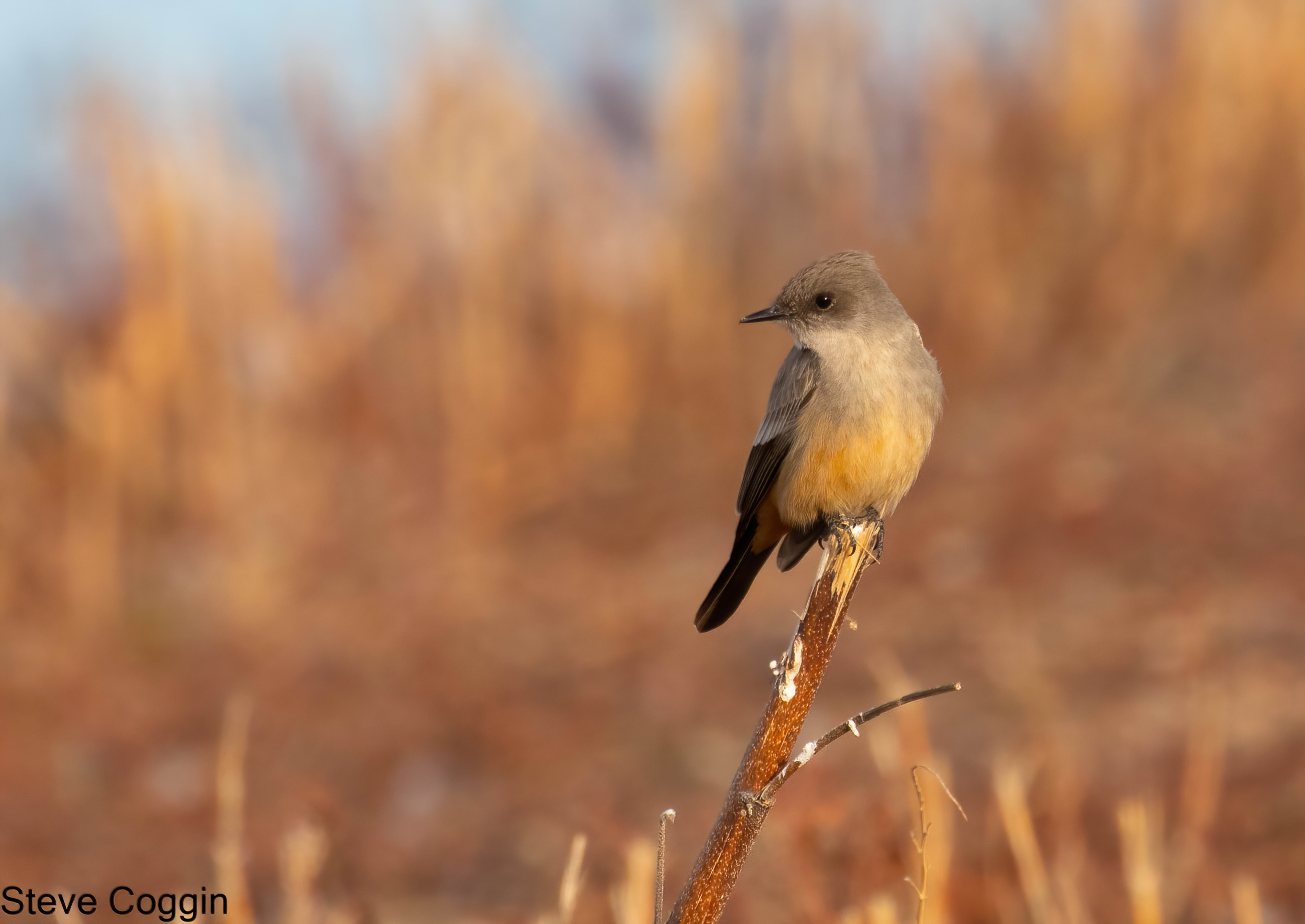
brush giving their plaintive calls. Overhead, flycatchers like the subdued Says Phobe (Sayornis saya)
and the dazzling Vermillion Flycatcher (Pyrocephalus obscurus) snap up insects
on the wing.
 |
Gambel's Quail (Callipepla gambelii).
Bosque del Apache National Wildlife Refuge, New Mexico. |
 |
Say's Phoebe (Sayornis saya).
Bosque del Apache National Wildlife Refuge, New Mexico.
|
 |
Male Vermillion Flycatcher (Pyrocephalus obscurus).
Pecha Dam State Park, New Mexico. |
Three different species of
bluebirds live in the bosque. The most
impressive is the bluest of the bluebirds, the Mountain Bluebird (Sialia
currucoides). The males of this
lovely species are turquoise on the head and back, sky blue on the breast and
fade to light blue on the belly.
 |
Male Mountain Bluebird (Sialia currucoides).
Bernardo Wildlife Management Area, New Mexico. |
Blackbirds (Family Icteridae) are
well represented in the bosque. Western
Meadowlarks (Sturnella neglecta) can be found singing, even in
winter. Brewer’s Blackbirds, (Euphagus
cyanocephalus) gather in large flocks to feed in fields and
perch in the tops of trees. Male Brewer’s
Blackbirds are iridescent black with yellow eyes and the females are brown with
dark eyes. We also found a single Yellow-headed Blackbird (Xanthocephalus xanthocephalus). With its black
body, bold white wing patches and bright yellow head, the Yellow-headed Blackbird stands out among the other blackbirds.
 |
Western Meadowlark (Sturnella neglecta) singing to the sunrise.
Mesilla Valley Bosque Wildlife Refuge, New Mexico.
|
 |
Male Brewer's Blackbird (Euphagus cyanocephalus).
Bosque del Apache National Wildlife Refuge, New Mexico. |
 |
Female Brewer's Blackbird.
Bosque del Apache National Wildlife Refuge, New Mexico. |
 |
Male Yellow-headed Blackbird (Xanthocephalus xanthocephalus).
Bosque del Apache National Wildlife Refuge, New Mexico. |
The bosque was once a continuous
forest following the Rio Grande through New Mexico.
The same environmental conditions that make
this area so biologically rich; fertile soil, mild climate and a steady water
supply, have also made it desirable to people.
Large swaths of the bosque have been converted to agriculture, the river
has been channelized and irrigation systems put into place.
Cities, large and small, have grown up on the
bosque, but natural areas remain that give us a glimpse of this unique
ecosystem.
 |
Bosque with hot air balloon.
Albuquerque, New Mexico |
Thanks to Dr. Richard Pockat for providing excellent photographs for this blog.




.jpg)


