Wednesday, May 1, 2024

Texas Hill Country: Springtime Flowers and Butterflies


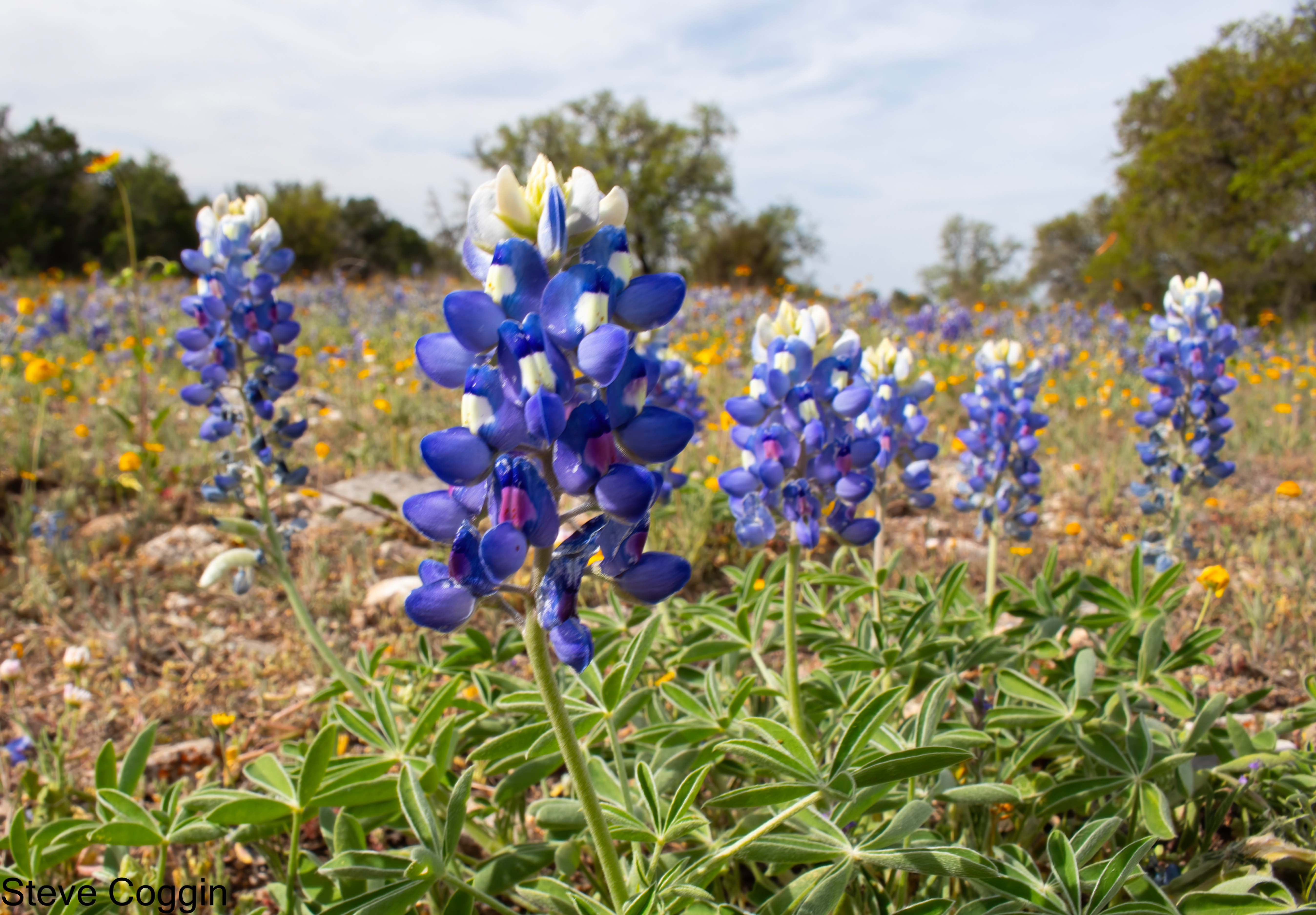
Texas Bluebonnets (Lupinus texenis) 
and Winecup (
Callirhoe involucrata).
Friedrich Wilderness Park,
Bexar County, Texas.

Driving northwest out of San Antonio a line of wooded hills appears on the horizon. This is the Balcones Escarpment, and it marks the beginning of the Texas Hill Country and the vast Edwards Plateau.  This area is dotted with ranches, forests of oak and juniper and grasslands. We visited the Texas Hill Country in April where we found a stunning show of wildflowers.  With these flowers came an abundance of butterflies.  

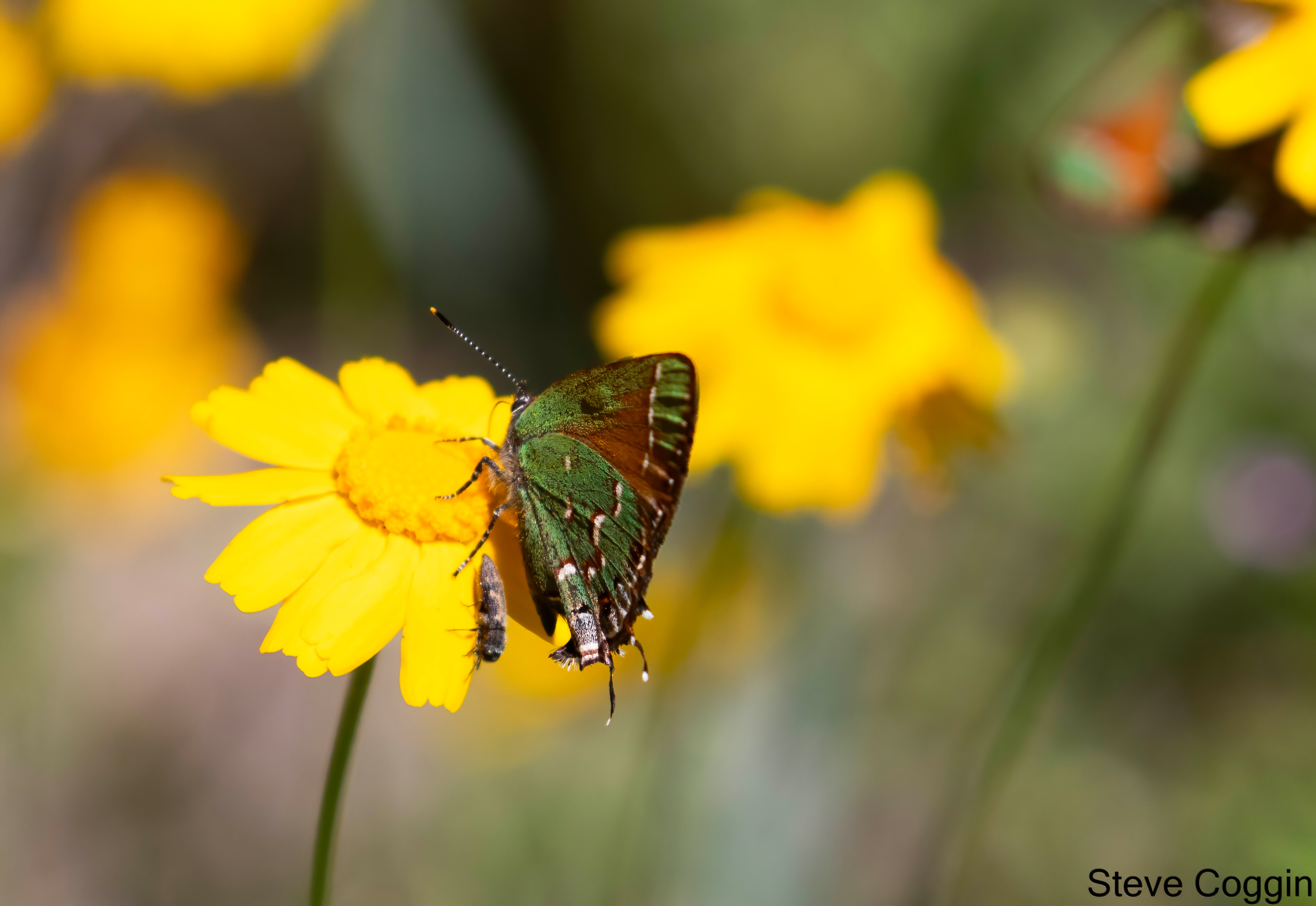
Western Green Hairstreak (Callophrys affinis) 
on 
Fineleaf Fournerved Daisy (Tetraneuris linearifolia).
Friedrich Wilderness Park,
Bexar County, Texas.

The iconic Texas wildflower is the Bluebonnet (Lupinus texensis). This member of the Pea Family (Fabaceae) is found throughout Texas and adjacent areas of other states and Mexico. Texas Bluebonnets have palmately compound leaves and, for a few weeks in spring, clusters of blue flowers.  The flowers of Texas Bluebonnets reminded the American settlers of the bonnets the womenfolk wore to protect them from the sun.  

Texas Bluebonnet.
Kerr Wildlife Management Area.
Kerr County, Texas. 

Many other flowers and butterflies graced the fields and forests. Here is a small sample.

Texas Flax (Linum hudsonioides).
Bandera County, Texas.
  

Hill Country Rain Lily (Cooperia pedunculata).
Friedrich Wilderness Park,
Bexar County, Texas.
 
Texas Vervain (Verbena halei).
Kerr Wildlife Management Area.
Kerr County, Texas. 
 
Fineleaf Fournerved Daisy.
Bandera County, Texas.

 Prairie verbena (Glandularia bipinnatifida).
Lost Maples State Natural Area.
Bandera County, Texas.
  
Texas Thistle (Crisium texanum).
Bandera County, Texas.
                        
White Prickly Poppy (Argemone albiflora).
Bandera County, Texas.
 

Prairie Penstemon (Penstemon cobaea). 
Friedrich Wilderness Park.
Bexar County, Texas.

Antelope-horns (Asclepias asperula) with flowers closed.
 Kerr Wildlife Management Area.
Kerr County, Texas. 

Antelope-horns with flowers open.
 Kerr Wildlife Management Area.
Kerr County, Texas. 

Red Admiral (Vanessa atalanta). 
Friedrich Wilderness Park.
Bexar County, Texas.

Pink Evening primrose (Oenothera speciosa).
Bandera County, Texas.
 

Texas Yellow Star (Lindheimera texana).
Bandera County, Texas.
 

Plateau Nerve-ray (Tetragonotheca texana).
Kerr Wildlife Management Area.
Kerr County, Texas. 
 
Edwards Least Daisy (Chaetopappa bellidifolia).
Kerr Wildlife Management Area.
Kerr County, Texas. 

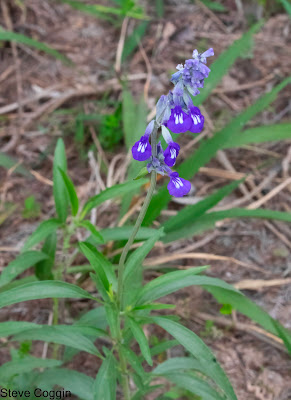
Mealy Blue Sage (Salvia farinacea).
Bandera County, Texas. 

Snapdragon Vine (Maurandya antirrhiniflora).
Bandera County, Texas. 

Question Mark (Polygonia interrrogationis).
Bandera County, Texas. 

Texas Bindweed (Convolulus equitans).
Bandera County, Texas.

Plateau Milkvine (Matelea edwardsensis).
Friedrich Wilderness Park.
Bexar County, Texas.

The Hill Country of Texas may seem harsh but it is a dazzling place in spring.  Dramatic displays of wildflowers grace the fields and roadsides.  These flowers in turn provide nectar and pollen for a profusion of butterflies.  All this happens before the heat of summer sets in and dries up the land.


Monday, April 15, 2024

Three Rare Texas Birds


Male Golden-cheeked Warbler (Setophaga chrysoparia).
Kerr Wildlife Management Area, Kerr County, Texas 

Texas is rare bird central for the United States.  The long border with Mexico and the southern projection of the state means many tropical species drift into Texas.  Diane and I, along with two friends, visited the San Antonio area to view the total solar eclipse this April.  While we did not see the eclipse (it was cloudy) we did find some rare birds. 

We encountered Golden-cheeked Warblers (Setophaga chrysoparia) at Lost Maples State Natural Area and Kerr Wildlife Management Area.  These striking birds have black and white bodies, black crowns, black throats, a black eye line, and golden feathers on each side of the face.  Females are more subtlety colored but still have the golden cheeks.  Golden-cheeked Warblers nest only in Texas and arrive from Central American and Mexico in early spring.  Males stake out territories in the Juniper-Oak forests, singing throughout the day.  After raising their young the Golden-cheeked Warblers depart Texas for the mountains of Mexico, Guatemala and Honduras. Golden-cheeked Warblers are an endangered species and face threats on both their breeding grounds and their wintering areas. In Texas, their nests can be parasitized by Brown-Headed Cowbirds (Molothrus ater) and in the tropics the Pine-Oak forests where they winter are being converted to agriculture. We were lucky enough to find male Golden-cheeked Warblers singing from exposed perches and gathering nest material.  

Male Golden-cheeked Warbler.
Kerr Wildlife Management Area, Kerr County, Texas. 

Black-capped Vireos (Vireo atricapilla) have a greenish-gray back and wings, white belly and breast and in the males a black cap with white spectacles.  Females and juvenile birds look similar, but their heads are gray.  These vireos breed in a small area of Oklahoma, central Texas and northern Mexico.  Black-capped Vireos winter in the scrub forests of western Mexico. Conservation efforts including Brown-headed Cowbird control and prescribed burns have allowed Black-capped Vireo numbers to increase in Texas and they are now listed as threatened rather than endangered.   We found Black-capped Vireos singing and skulking in the brush at Kerr Wildlife Management Area.

Black-capped Vireo (Vireo atricapilla).
Kerr Wildlife Management Area, Kerr County, Texas. 

An unexpected bonus bird turned up at Lost Maples State Natural Area.  A male Tropical Parula (Setophaga pitiayumi) was singing its buzzy song in the tops of the trees along Can Creek.  This tiny warbler is found throughout the American tropics but in the United States they breed only in south Texas.  Tropical Parulas have a blue back, white wing bars, a yellow throat and belly, and in the males, an orange breast.  Ironically, climate change may cause an increase in numbers of Tropical Parulas in the United States but reduce their numbers in parts of the tropics.  

Male Tropical Parula (Setophaga pitiayumi) singing.
Lost Maples State Natural Area, Bandera County, Texas

While the Texas Hill Country is not the Lower Rio Grande Valley, we had an excellent birding experience.  We saw some exciting birds in that slice of Texas.

Male Tropical Parula.
Lost Maples State Natural Area, Bandera County, Texas. 

Monday, April 1, 2024

Sapsucker Banquet


Male Yellow-bellied Sapsucker (Sphyrapicus varius)
 on River Birch (Betula nigra).
Rowan County, North Carolina. 

Sapsuckers are a group of woodpeckers native to North America.  They use their strong, chisel-like beaks to drill rows of holes tree trunks. These holes tap the phloem of the tree that exudes sugary sap.  The tree can repair the damage and each hole yields sap for only a short period of time.  Sapsuckers feed on the sap and the insects that are attracted to it. 

There are four species of Sapsuckers, three are found in western North America and one, the Yellow-bellied Sapsucker (Sphyrapicus various), is found in the east.  Yellow-bellied Sapsuckers breed in the forests from Alaska to eastern Canada and in the northeastern United States.  This species of Sapsucker spends the winter in southeastern and southcentral United States, Mexico, Central America and the Caribbean. 

 Yellow-bellied Sapsuckers are medium-sized woodpeckers.  They have a black and white pattern of feathers that is typical of woodpeckers, with a bold white band running down the wing and yellow on the belly.  Both male and female Yellow-bellied Sapsuckers have black and white stripes on the face and a red crown. Males also have a red throat.  Immature Yellow-bellied Sapsuckers have a more brownish look and the stripes on the head are less distinct. 

 We have many opportunities to watch Yellow-bellied Sapsuckers during their winter residency.  One of the Sapsucker’s favorite trees in our yard is a mature River Birch (Betula nigra).  The upper trunk of this tree is riddled with Sapsucker holes that they visit regularly.  Sapsuckers will also come to the suet feeders in the yard and get a free lunch.  

Yellow-bellied Sapsucker holes in the trunk of a River Birch. 
Rowan County, North Carolina. 

Male Yellow-bellied Sapsucker feeding on suet.
Rowan County, North Carolina. 

A number of other bird species take advantage of the holes the Sapsuckers make. One day this winter an immature Yellow-bellied Sapsucker was drilling and feeding at the holes.  Other birds were hanging around too.  A large flock of Pine Siskins (Spinus pinus) was eating thistle seed from a feeder but some of the Siskins would fly up to the top of the Beech and sip some sap next to the Sapsucker.  

Immature Yellow-bellied Sapsucker.
Rowan County, North Carolina. 
a
Immature Yellow-bellied Sapsucker
and Pine Siskins (Spinus pinus). 
Rowan County, North Carolina. 

Pine Siskins feeding at Sapsucker holes.
Rowan County, North Carolina. 

A female Purple Finch (Haemorhous purpureus) also took advantage of the Sapsucker’s work and fed at the holes.  A Yellow-rumped Warbler (Setophaga coronata) was picking insects from the sap and even a Downy Woodpecker (Picoidies pubescens) could not resist the banquet provided by the Yellow-Bellied Sapsucker.     

Female Purple Finch (Haemorhous purpureus)
feeding at Sapsucker holes.
Rowan County, North Carolina.  

Yellow-rumped Warbler (Setophaga coronata).
Rowan County, North Carolina. 

Yellow-rumped Warbler at the Sapsucker holes.
Rowan County, North Carolina. 

A female Downy Woodpecker (Picoidies pubescens).
Rowan County, North Carolina. 

The holes drilled by Yellow-bellied Sapsuckers can damage trees and make them more susceptible to disease.  But Sapsucker holes also set up a whole new set of ecological interactions, between the trees, the insects and the birds.  On balance, I like having Yellow-bellied Sapsuckers spend the winter with us. 

Male Yellow-bellied Sapsucker.
Rowan County,  North Carolina. 


Friday, March 15, 2024

Nemesis Birds


Bahama Mockingbird (Mimus grundlachii).
Jetty Park,  Port Canaveral, Florida.  

The nemesis bird is an idea going around the birding community.  It is a bird that someone seeks but cannot find.  There are many definitions for a nemesis bird but for me it is one I have tried to find several times but has eluded me.  

Bahama Mockingbird.
Jetty Park, Port Canaveral, Florida. 

The Bahama Mockingbird (Mimus grundlachii) is, of course a native to the Bahamas and a few other spots in the northern West Indies.  Every few years a Bahama Mockingbird makes its way to Florida and birders flock to see it. If I happened to be in the area when one shows up, I would go looking too. In May 2018 I made three attempts to find the Bahama Mockingbird in Palm Beach County without success.  Then in April 2021 another was in Palm Beach County. Diane and I tried for this one too, and missed.  Finally, in April 2023 we tracked down the elusive Bahama Mockingbird in the campground of Jetty Park at Port Canaveral.  It was singing and fighting with the local Northern Mockingbirds (Mimus polyglottos) between the motor homes and giant cruise ships.  

I have not been as lucky with other nemesis birds.  We have made two trips to southeastern Arizona and saw many birds that are characteristic of that area like Elegant Trogons (Trogon elegans), Mexican Chickadees (Poecile sclateri), Rivoli’s Hummingbirds (Eugenes fulgens) and Elf Owls (Micrathene whitneyi).  But one bird has eluded us there, the Montezuma Quail (Cyrtonyx montezumae).  Montezuma Quail are found along the southern US border in the deserts of Arizona, New Mexico and Texas and down into Mexico.  Montezuma Quail are small, round, ground dwelling birds. Females are mottled brown, but the males have a dark brown belly, black and white sides and a boldly patterned face. On our trips to Arizona, we were constantly running into people who had just seen Montezuma Quail on the trail or crossing the road 10 minutes before we arrived.  The Montezuma Quail is still a nemesis.

Montezuma Quail (Cyrtonyx montezumae).
Painting by Louis Agassiz Fuertes. 1928.
 https://commons.wikimedia.org/wiki/File:Cyrtonyx_montezumaeEBP20A.jpg

California Condors (Gymnogyps californianus) are critically endangered birds that were on the brink of extinction in the 1980s.   These giant vultures once fed on the carcasses of mastodons and mammoths and ranged across much of North America. Extinction of the giant mammals reduced the California Condor's population and range, but when Lewis and Clark reached the mouth of the Columbia River in 1805, they found   Condors living there.  The population of the California Condors continued to decline in the 20th century due to agricultural pesticide use and lead poisoning until only 27 birds survived.  These last holdouts of the ice age were captured and used to begin a captive breeding program.  Young California Condors from the program were raised and released into the wild over the decades. Now a population of over 500 birds live in California, Arizona and Utah.     

California Condor (Gymnogyps californianus).
Painting by Fredrick Polydore Nodder, 1797.
https://commons.wikipedia.org/wiki/
File:The_Naturalist%27s_Miscellany_Vol_9_Pl_301_California_condor.jpg 

We have made two valiant attempts to see these free-flying California Condors.  In June 2013 we went to Big Sur in California where we scanned the cliffs and watched the skies, to no avail.  A park ranger told us he saw one driving to work that morning, but we struck out.  In August 2021 we sought the Condors in Northern Arizona, at Marble Canyon and the Vermillion Cliffs.  Again, no luck.  A Navajo lady working at the Marble Canyon Lodge told us she had not seen the Condors for a couple of weeks. She said we should come back in the breeding season.  Nemesis.    

Harris’s Sparrows (Zonotrichia querula) are neither critically endangered nor even rare.  We just don’t spend time where they live.  Harris’s Sparrows breed in the boreal forests of northern Canada and winter on the Great Plains.  In January 2023 a stray Harris’s Sparrow was hanging around Albuquerque, New Mexico.  Diane and I were in the area with a group of birders to experience the giant flocks of Snow Geese (Anser caerulescens) along the Rio Grande.  Our group made two visits to the location where the Harris’s Sparrow was seen, but we had no luck.  Then in the winter of 2024 a Harris’s Sparrow was reported in our own state.  It was on the campus of Warren Wilson College just east of Asheville, North Carolina. This unique college has a farm adjacent to the campus and students work the farm, raising row crops, sheep, cattle and pigs.  

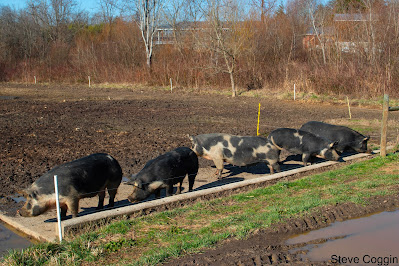
The farm at Warren Wilson College.
Swannanoa, North Carolina. 

Pigs in their pen. 
Warren Wilson College.
Swannanoa, North Carolina. 


A curious pig.
Warren Wilson College.
Swannanoa, North Carolina.  

On my first trip for the Harris’s Sparrow in North Carolina, it was the familiar routine.  People had just seen the Harris’s Sparrow. "It was on the other side of the pond".  "In that patch of blackberries". "Down by the pig pen".  It was there, but I could not find it.  I was discouraged.  The sparrow was so close, I missed it in New Mexico and now in North Carolina.  It was a nemesis.  The Harris’s Sparrow was still being reported the next week so Diane and I went back.  We met a couple of birders from South Carolina who had been there a while but had not seen the sparrow.  After we had searched for a couple of hours Diane cried, “There it is”. And there it was, down in the pen, eating swine feed.  It was a large sparrow, with a brown head, pink beak, a white throat and breast and a black bib. It was an immature bird, over a thousand miles from where it should be. 

Harris's Sparrow (Zonotrichia querula) feeding in a pig pen.
Warren Wilson College.
Swannanoa, North Carolina. 


Harris's Sparrow.
Warren Wilson College.
Swannanoa, North Carolina. 

Diane went to tell the South Carolina birders she had found the sparrow.  While she was gone, our target flew into a tangle of briars.  The South Carolinians hustled over, and the four of us peered into the blackberry canes looking for the Harris’s Sparrow.  Then the sparrow flew up into a sapling.  It sat on the bare branches for several minutes, giving all a good look and a terrific photo op.  Harris’s Sparrow, nemesis no more.  


Friday, March 1, 2024

Pill Bugs


 Pill Bug (Armadillidium vulgare).
Rowan County, North Carolina. 

Pill Bugs are not really bugs; they are not even insects.  They are actually terrestrial Crustaceans and like their better-known relatives, lobsters and crabs, they have gills.  Pill Bugs must keep their gills moist to exchange oxygen and carbon dioxide.  Because of this requirement these interesting little animals are restricted to humid environments.  Gills tell a story about the evolutionary history of Pill Bugs. Their ancestors lived in ancient oceans before the time of the dinosaurs and crawled onto land 300 million years ago to eventually become our present-day Pill Bugs.  Pill Bugs are detritivores, and live in the upper layers of the soil.  They consume dead plant material and the microscopic decomposers found on the rotting vegetation.  

Pill Bug rolled up in protective posture.
Rowan County, North Carolina. 

Pill Bugs are known by a number of common names including Roly-polys, Armadillo Bugs and Woodlice. The name woodlouse comes because they are often found under rotting logs.  The names Armadillo Bug and Roly-poly refer to the Pill Bug habit of rolling into a ball as a protective behavior.  When they are rolled up, Pill Bugs resemble pills giving rise to that common name.


Video of Pill Bug crawling.
Rowan County, North Carolina. 

Whether they are called Woodlice, Armadillo Bugs, Roly-polys or Pill Bugs these creatures are classified in the Order Isopoda. The name Isopoda comes from the Greek meaning “same feet” because each of their seven sets of legs are the same size.  Contrast this with crabs (Order Decapoda) that have legs of vastly different sizes, some specialized for feeding (claws), some for walking and some for swimming (swimmerets). The most common Pill Bug in our area is Armadillidium vulgare.  This native of Europe has spread around the world with humans and is found in temperate regions of six continents.  

A group of Pill Bugs in soil. 
Many different sizes and colors are present. 
Rowan County, North Carolina.

Adult Pill Bugs are about ¾ inch long and dark brown or gray in color with a segmented exoskeleton that covers their upper surface. They have a two compound eyes and a pair of antennae on the head.  Each of the seven main body segments has two legs.  Pill Bugs take about a year to mature and must molt their exoskeleton to grow to a larger size.  After molting Pill Bugs are lighter in color but darken up quickly. It is common to find a wide range of Pill Bug sizes because they are always growing through their different stages.   

Pill Bug on a leaf.
Rowan County, North Carolina. 

Pill Bugs do not bite or sting nor do they transmit human diseases.  Because of their benign nature and their downright cuteness, Pill Bugs are kept as pets by people around the world.  If you want to see some pill bugs, look under logs or rocks.  All the Pill Bugs photographed for this blog were sleeping under a flowerpot on our porch.  Take a look, and you will find these fascinating creatures quietly living their lives.