Friday, August 1, 2025

St. Paul Island, Part 2


Reindeer (Rangifer tarandus) calves.
St. Paul Island, Alaska. 

St. Paul is one of the Pribilofs.  These small, tundra covered islands are hundreds of miles from mainland Alaska in the middle of the Bering Sea.  St. Paul Island has huge Northern Fur Seal (Callorhinus ursinus) rookeries, seabird nesting cliffs and many species of water and land birds.  St. Paul also has its own subspecies of Arctic fox (Vulpes lagopus) and an introduced herd of Reindeer (Rangifer tarandus).

Reindeer herd.
St. Paul Island, Alaska. 

Arctic Fox (Vulpes lagopus).  The blue subspecies
is endemic to the Pribilofs. 
St. Paul Island, Alaska. 

Northern Fur Seals (Callorhinus ursinus).
St. Paul Island, Alaska. 

The King Eider Hotel. 
The airport hangers are on the right. 
St. Paul Island, Alaska. 
Photo courtesy of Mr. Steve Kline. 

Our group of four birders stayed at the King Eider Hotel at the St. Paul airport in June.  Despite being right next to the single runway we were not bothered by aircraft noise.  There are only three scheduled flights per week.  Our St. Paul Tour guides shuttled us between the good birding locations on the island in a spacious blue van and we never got stuck once.  

St. Paul Island Tour van.
St. Paul Island, Alaska. 
Photo courtesy of Mr. Steve Kline. 
 

Eurasian Green-winged Teal (Anaus crecca crecca).
St. Paul Island, Alaska. 

Ducks and geese are found along the coast, on freshwater ponds and in marshes across the island.  The North American Green-winged Teal (Anas crecca carolinensis) is a small dabbling duck found across North and Central America, including St. Paul Island.  Mixed in with the North American Green-winged Teal were a smattering of Eurasian Green-winged Teal (Anas crecca crecca).  The Eurasian subspecies is found throughout the Old World and reach their easternmost limit in Western Alaska.  They look very similar to North American Green-winged Teal but lack the white vertical line on the side.  Some author ties consider them two different species. 


Male Tufted Duck (Aythya fuligula) showing his tuft. 
St. Paul Island, Alaska. 

A few Tufted Ducks (Aythya fuligula) were diving on freshwater ponds.  These Eurasian ducks are related to Greater and Lesser Scaup (A. marila  and A. affinis) but the male Tufted Duck has a crest on the back of the head.   


A flock of Harlequin Ducks (Histronicus histronicus).
St. Paul Island, Alaska. 

Harlequin Ducks (Histronicus histronicus) are sea ducks found along coasts in winter but breed in the rapids of rivers.  We saw many Harlequin Ducks along the rocky shores of St. Paul Island.  The males are spectacularly patterned ducks with bold white, black, gray and chestnut feathers. 


Male King Eider (Somateria spectabilis).
St. Paul Island, Alaska. 

King Eiders (Somateria spectabilis) are large sea ducks that breed on the tundra of the high arctic.  These impressive ducks have a black-and-white body, buffy breast, blue head with a pale green cheek patch and an orange knob over a pink beak.   

Emperor Goose (Anser canagicus).
St. Paul Island, Alaska. 

One day we were lucky enough to see an Emperor Goose (Anser canagicus) on the north end of the island.  This beautiful Eurasian goose is barred gray and black with a black throat and white head.  There is a breeding population of Emperor Geese in Western Alaska but the one we saw on St. Paul was probably migrating.   


Rock Sandpiper (Caladris ptilocnemis),
St. Paul Island, Alaska. 

There were shorebirds on St. Paul, but most were not on the shore.  We found them around ponds and in marshes.  The most common of these was the Rock Sandpiper (Caladris ptilocnemis).  Rock Sandpipers are found in Eastern Siberia and Western Alaska. During the breeding season they have a reddish brown and black back and the Pribilof subspecies has a black patch on the belly. 


Red-necked Phalaropes (Phalaropus lobatus).
St. Paul Island, Alaska. 

Red Phalarope (Phalaropus fulicarus).
St. Paul Island, Alaska.

Red-necked (Phalaropus lobatus) and Red Phalaropes (Phalaropus fulicarus) were on the ponds stalking the shallows and spinning to stir up their food. 


Wood Sandpiper (Tringa glareola).
St. Paul Island, Alaska. 

The Wood Sandpiper (Tringa glareola) breeds from Scotland to Russian Siberia and is a regular migrant on St. Paul.  We saw several Wood Sandpipers feeding in shallow ponds around the island. 


Lapland Longspur (Calcarius lapponicus).
St. Paul Island, Alaska. 

Snow Buntings (Plectrophenax nivalis).
St. Paul Island, Alaska. 

There are only a few species of perching birds on St. Paul Island.  Lapland Longspurs (Calcarius lapponicus) were on territories across the tundra with males singing from the tops of small sticks. Snow Buntings (Plectrophenax nivalis) flashed black and white before us as we walked.


Gray-crowned Rosy-finch (Leucosticte tephrocotis umbrina).
St. Paul Island, Alaska. 

Gray-crowned Rosy-finches (Leucosticte tephrocotis umbrina) watched our coming and goings with interest.  These large finches have a gray head, black face and its body feathers are brown and pink.  We saw the endemic Pribilof Island subspecies of the Gray-crowned Rosy-finch on St. Paul Island.


The Pribilof subspecies of
Pacific Wren (Troglodytes pacificus alascensis).
St. Paul Island, Alaska. 

The Pribilofs also have an endemic subspecies of Pacific Wren (Troglodytes pacificus alascensis).  The Pribilof subspecies is larger than its mainland counterpart and has a longer beak.


Siberian Rubythroat (Calliope calliope).
St. Paul Island, Alaska. 

One of the reasons birders flock to St. Paul is the chance to seen vagrant species from Asia.  During our week on the island, we had opportunities to see some of these Siberian birds.  On our first afternoon we went to the Upper Quarry, a chasm filled with lichen-covered boulders. In the quarry our guide heard the song of a Siberian Rubythroat (Calliope calliope). A native of Western Asia, this Siberian Rubythroat was off course on its migration from Southern Asia to Siberia.  This small brown bird had a black and white face and an iridescent red throat. 


Female Hawfinch (Coccothraustes coccothraustes).
St. Paul Island, Alaska. 

Hawfinches (Coccothraustes coccothraustes) are small birds with large, seed-crushing beaks, gray bodies, white patches on the wings and a black chin.  A pair had taken up residence on Hutchinson Hill at the northeastern corner of the island and may be the founders of a breeding population. 


Female Common Rosefinch (Carpodacus erythrinus).
St. Paul Island, Alaska. 

We saw a female Common Rosefinch (Carpodacus erythrinus) at the top of the cliffs at Marunich on the north side of St. Paul. This tiny bird was brown with faint stripes and a little finchy beak.


Common Cuckoo (Cuculus canorus). 
St. Paul Island, Alaska. 

Common Cuckoo.
St. Paul Island, Alaska. 

Our guides worked very hard to show us a Common Cuckoo (Cuculus canorus) that appeared on the island. This fascinating bird is usually found from Europe to East Asia.  Common Cuckoos are nest parasites.  Female Common Cuckoos lay their eggs in the nests of other birds and the baby cuckoos are raised by the foster parents at the expense of their own nestlings. This Common Cuckoo was near the Zapadni Ravine on the south side of the island.  We made numerous visits to the area but finally, on our last full day, the cuckoo flew across the road in front of the van.  It perched on rocks and on the top of Puchki (Angelica lucida) stems.  It flew across the road into the nearby seal rookery and let everyone get a good look.  


Arctic Willow (Salix arctica) in full flower.
St. Paul Island, Alaska. 

The compound leaves of Nootka Lupine (Lupinus nootkatensis).
St. Paul Island, Alaska. 

Nootka Lupine flowers.
St. Paul Island, Alaska.

Langsdorff's Lousewort (Pedicularis landsdorffii) in flower.
St. Paul Island, Alaska. 

Our visit was in June and spring as was beginning on St. Paul.  The hardy tundra flora was putting on a show.  Arctic Willow (Salix arctica) only grows a few inches tall and was in full flower.  Nootka Lupine (Lupinus nootkatensis) with its compound leaves and blue flowers was just coming out.  Langsdorff's Lousewort (Pedicularis langsdorffii) has lavender flowers and stood out on the tundra. 

Lichens on boulder.
St. Paul Island, Alaska. 


Sitka Spruce (Picea sitchensis).
St. Paul Island, Alaska. 

Lichens, those odd symbiotic fusions of fungus and alga, encrusted rocks from the Quarry to the nesting cliffs of seabirds.  There are a few trees on St. Paul Island.  Members of the United States Coast Guard planted a small stand of Sitka Spruce (Picea sitchensis) near the Coast Guard Station.  These trees are decades old and have reached a height of just over a foot.  The locals call this the "St. Paul National Forest".

St. Paul Tour guides; Mariah, Luis, Sully and David.
St. Paul Island, Alaska. 

We would like to thank the folks from St. Paul Tour; Sulli, David, Luis and Mariah.  They helped us have an unforgettable experience on this remote island.


Tuesday, July 15, 2025

St. Paul Island, Part 1


Horned Puffin (Fratercula corniculata) perched on a lava cliff.
St. Paul Island, Alaska,

There is a small group of islands in the Bering Sea, 300 miles from the mainland of Alaska, called the Pribilofs.  The islands of this archipelago are rimmed by cliffs and boulders and black sand beaches.  The weather is often windy, cold, foggy, misty or rainy, and that’s in summer.  

Last year's flower head of Puchki (Angelica lucida).
Puchki is the largest native plant on the Pribilofs. 
St. Paul Island, Alaska. 

The islands are covered by tundra and the tallest native vegetation is the flowering stalks of Wild Celery, Puchki (Angelica lucida).  But despite these conditions, the islands have an astonishing array of wildlife, from the world’s greatest largest concentration of Northern Fur Seals (Callorhinus ursinus) to sea birds nesting on the cliffs.  Then there are the vagrant birds from Asia who get blown off course and use the islands to rest and feed for the few days then fly back to where they belong. 

Diane, two friends and I visited St. Paul, the largest of the Pribilof islands for a week in June. We were hosted by St. Paul Island Tour.  Their guides showed us the birds, mammals, plants, and the stark, stunning landscapes of this remote island.  


Thick-billed Murres (Uria lomvia).
St. Paul Island, Alaska. 

Thick-billed Murres.
St. Paul Island, Alaska. 

The sea cliffs of St. Paul are the nesting sites of many seabirds.  The Alcids (Family Alcidae) were well represented on the cliffs. These birds spend most of their life at sea where they fly underwater using their wings to pursue fish and other marine creatures.  Alcids only come to land to lay their eggs and raise their chicks. Many Alcids resemble penguins with the black-and-white color pattern and upright posture. The largest Alcids on the cliffs were the elegant black-and-white Thick-billed Murres (Uria lomvia).


Tufted Puffins (Fratercula cirrhata).
St. Paul Island, Alaska. 

Tufted Puffin.
St. Paul Island, Alaska. 

Puffins are also in the Alcidae and two species, Tufted Puffins (Fratercula cirrhata) and Horned Puffins (Fratercula corniculata) were setting up nests on St. Paul.  They were in full breeding plumage with large, brightly colored beaks.  Tufted Puffins are black with a white face, bright orange beak and bold yellow tufts that sweep from behind the eyes and curl down the neck.  Horned Puffins have black backs and wings, a white belly and face, a orange and yellow bill and a small black horn extending above the eye.   

Horned Puffins.
St. Paul Island, Alaska. 

Parakeet Auklets (Aethia psittacula), Least Auklets (Aethia pusilla) and Crested Auklets (Aethia cristatella) were also mating and building nests of the cliffs.  These Alcids are smaller than the puffins but share the black-and-white color pattern. 


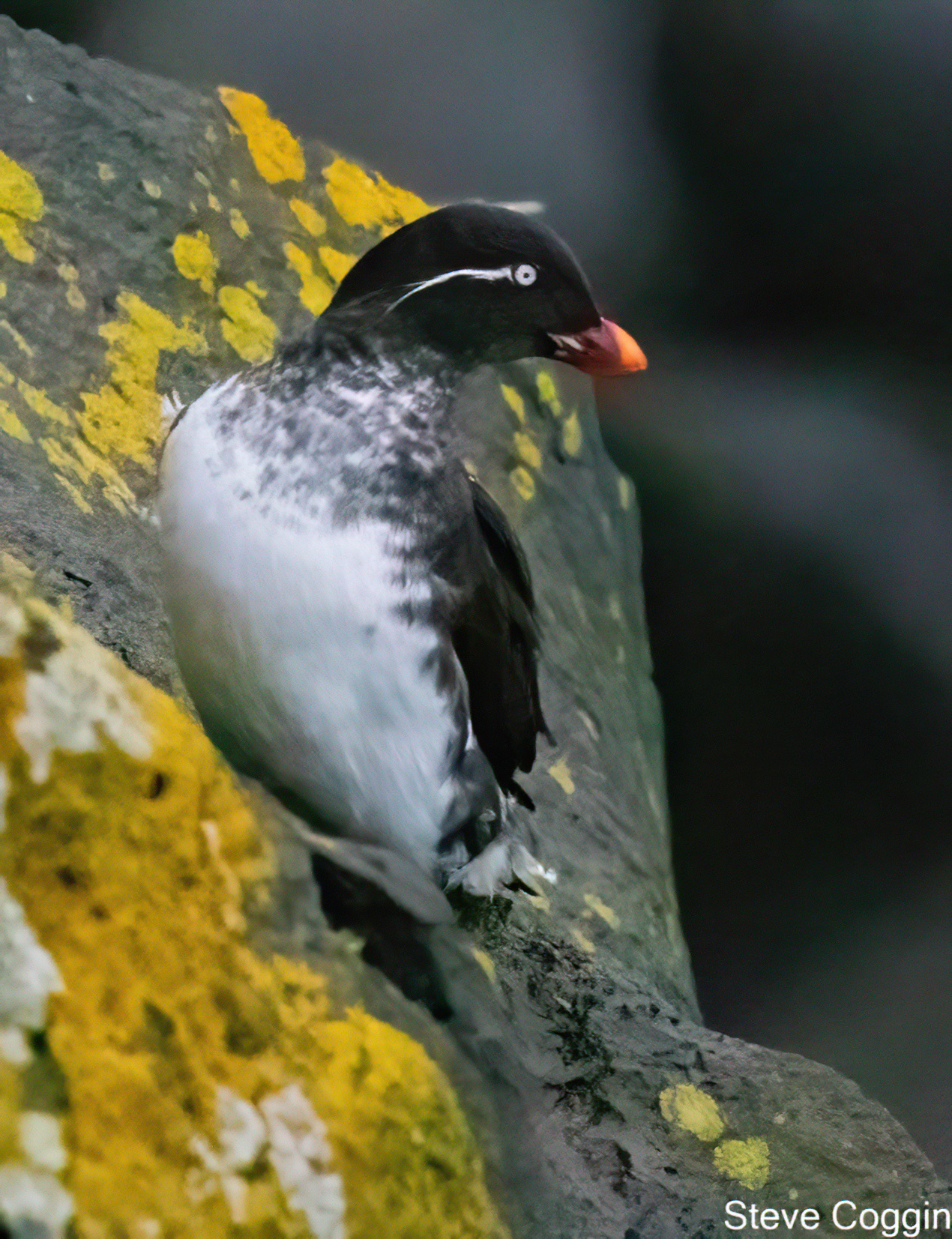
Parakeet Auklet (Aethia psittacula).
St. Paul Island, Alaska. 

Parakeet Auklet.
St. Paul Island, Alaska. 

Least Auklets (Aethia pusilla).
St. Paul Island, Alaska. 

Crested Auklets (Aethia cristatella).
St. Paul Island, Alaska. 

Parakeet Auklets are black on the head and back, have a white belly, a fine white stripe behind the eye and an orange beak that landed them the parakeet name.  Least Auklets are the smallest of the group.  They have a black back, a white line running back from the eye and a mottled black-and-white belly. The most impressive species of the group is the Crested Auklet. They are black on the back, gray on the belly, have a white stripe running back from the eye, and a jaunty black plume curling over the orange beak.

Ancient Murrelets (Synthliboramphus antiquus).
St. Paul Island, Alaska. 

Ancient Murrelet.
St. Paul Island, Alaska. 

The Ancient Murrelet (Synthliboramphus antiquus) is another species of Alcid we saw on St. Paul. They have a black-and-white head, gray back and wings and a short beak.  A pair of Ancient Murrelets were courting in the surf just off a beach and would even come ashore to perch on the kelp covered rocks.


Red-faced Cormorants (Urile urile) nesting on a cliff.
St. Paul Island, Alaska. 


Red-faced Cormorant.
St. Paul Island, Alaska. 

Red-faced Cormorants (Urile urile) are found across the Northern Pacific from Alaska, along the Aleutian chain to Russian Asia and Japan.  They are iridescent black and during the breeding season have a bright red and blue patch of skin around the eye.  Red-faced Cormorants swim underwater and catch fish with their hooked beaks.


Northern Fulmar (Fulmarus glacialis).
St. Paul Island, Alaska. 

Another seabird on the cliffs of St. Paul is the Northern Fulmar (Fulmarus glacialis).  This large bird looks like a gull, but it is more closely related to the petrels and shearwaters (Family Procellariidae). The Northern Fulmar is found in the Northern Atlantic and Pacific Oceans and feeds at sea on fish, shrimp, squid and other marine animals.  Northern Fulmars come to land only to breed on sea cliffs where they raise a single chick. 


Slaty-backed Gull (Larus schistisagus) (left)
 and Glaucous-winged Gulls (Laurs glaucescens)
St. Paul Island, Alaska. 

St. Paul Island is the home to many gulls.  The largest of these is the Glaucous-winged Gull (Larus glaucescens).  It has a white head, breast and belly with a gray back and wings.  Glaucous-winged Gulls have a yellow bill with a red spot and pink legs.  The Slaty-backed Gull (Larus schistisagus) is native to Northwestern Asia, but a small population is resident in Western Alaska.  One of these large, dark-backed gulls showed up at Salt Pond in St. Paul Village.  The Slaty-backed Gull was resting on the mud flats with a group of Glaucous-winged Gulls where the size difference and wing color made it stand out.   

Black-legged Kittiwake (Rissa tridactyla).
St. Paul Island, Alaska. 

Red-legged Kittiwakes nesting (Rissa brevirostris).
St. Paul Island, Alaska. 

The most interesting gulls were the kittiwakes. There are two species, the Black-legged Kittiwake (Rissa tridactyla) and the Red-legged Kittiwake (Rissa brevirostris) and both breed on St. Paul Island.  Black-legged Kittiwakes are found around the Northern Atlantic and Pacific.  Red-legged Kittiwakes are restricted to the North Pacific and most of the world’s population breeds on the Pribilofs. Both species of kittiwakes nest on the sea cliffs among the murres, puffins and auklets.


Male Northern Fur Seal (Callorhinus ursinus) 
on his territory.
St. Paul Island, Alaska. 

Male Northern Fur Seal bellowing.
St. Paul Island, Alaska. 

Young male Northern Fur Seals wrestling in the surf.
St. Paul Island, Alaska. 

Over one million Northern Fur Seals, half the world’s population, arrive on the Pribilofs in early summer to breed. Males were hauling up on the beaches of St. Paul in June and setting up territories.  The males fast the entire time they are on the beaches and lose about one third of their body weight.  Females appear later, give birth, then mate within a week.  The large males were bellowing and running off the young bachelors who trespassed on their territories.  

The tundra and coasts of St. Paul offered new discoveries every day.  There were so many remarkable things that another blog will be needed to recount them.  Thanks to Sulli, David, Luis and Mariah of St. Paul Island Tour for showing us these wonders. 


Tuesday, July 1, 2025

Life at 71 North


Whale Bone Arch.
This arch made from the ribs of a Bowhead Whale
(Balaena mysticetus) commemorates
the whaling tradition of the Inupiat people. 
 Utqiagvik, Alaska.

Utqiagvik, Alaska, the northernmost town in the United States, lies at 71 degrees north latitude. With a population of about 5000, Utqiagvik perches on the edge of the Arctic Ocean 300 miles north of the Arctic Circle.  The North Pole is 1300 miles north with nothing but a frozen but melting ocean barring the way.  The town is not connected to the rest of the world by road and can only be reached by boat, when the sea is clear of ice, or by aircraft. 

Traditional whaling boat.
Utqiagvik, Alaska. 

Inupiat people have lived in the area for 1500 years and continue there today. They hunt Bowhead Whales from small boats, continuing a tradition that has lasted more than a millennium.  They also hunt seals and take birds for food.  Utqiagvik is surrounded by low lying tundra, with many small lakes and ponds.  All this is underlain by permafrost. For much of the 19th and 20th centuries Utqiagvik was known as Barrow, named for nearby Point Barrow.  The name of the town was changed back to Utqiagvik by referendum in 2016. 

Pectoral Sandpiper (Calidris melanotos).
Utqiagvik, Alaska.

Pectoral Sandpiper.
Utqiagvik, Alaska.

Diane, two friends and I visited Utqiagvik in June to see this unique place and the birds that were beginning to nest on the tundra.  Shorebirds were abundant and despite the persistent snow, they were pairing up and mating.  Pectoral Sandpipers (Calidris melanotos), with their streaky, puffed-out breasts and rich, repeated call were the most abundant of the sandpipers. 

Dunlin (Calidris alpina).
Utqiagvik, Alaska.
 
Semipalmated Sandpiper (Calidris pusillla).
Utqiagvik, Alaska.

Dunlins (Calidris alpina) and Semipalmated Sandpipers (Calidris pusilla) were in their breeding plumage and much more colorful than when we see them in the south during winter.  

Female Red-necked Phalarope (Phalaropus lobatus)
sitting on nest.

Utqiagvik, Alaska.

Female and male Red-necked Phalarope.
Utqiagvik, Alaska.

Female Red Phalarope (Phalaropus fulicarius).
Utqiagvik, Alaska.

The most brilliant shorebirds were the Red-necked Phalaropes (Phalaropus lobatus) and Red Phalaropes (Phalaropus fulicarius) .  These delicate sandpipers don’t just wade, they can light on the water like a duck.  Phalaropes often spin on the surface and stir up the sediment with their feet.  This disturbs insects and other small creatures, and the Phalaropes pluck them from the water.  Phalaropes are also distinctive because the females are more brightly colored than the males.  We sometimes see these Phalaropes in North Carolina during the winter when their coloration is a much more subdued white and gray. 
 
Male Pacific Golden Plover (Pluvialus fulva).
Utqiagvik, Alaska.

Female Pacific Golden Plover.
Utqiagvik, Alaska.

Pacific Golden Plovers (Pluvialus fulva) are large shorebirds that nest on the tundra of Eastern Asia and in a few areas of Western Alaska.  During the breeding season males have a black breast and throat, a bold white line that runs from above the eye and down the neck and the side of breast.  The backs of Pacific Golden Plovers give them their name with gold, black and white feathers. Females have a similar pattern but not quite as vividly colored as the males.  

A large flock of King Eiders (Somateria spectabiliis)
flying over the frozen Arctic Ocean.
Utqiagvik, Alaska.

Greater White-fronted Goose (Anser albifrons).
Utqiagvik, Alaska. 


Snow Geese (Anser caerulescens). 
Utqiagvik, Alaska.

Tundra Swans (Cygnus columbianus).
Utqiagvik, Alaska.

Ducks, geese and swans are common nesters on the tundra.  King Eiders (Somateria spectabilis) were not nesting when we visited but there were large flocks flying over the sea ice. Greater White-fronted Geese (Anser albifrons) breed across Northern parts of North America and Eurasia. These medium-sized geese have orange legs, a pink bill, brown body and black bars on the belly and were pairing up to nest.  A flock of Snow Geese (Anser caerulescens) did a flyby in the brilliant arctic sun.  This group of Snow Geese were the white phase with black wingtips.  Tundra Swans (Cygnus columbianus) were also in breeding pairs in the tundra ponds.  These white swans build nests of plant material at the edge of ponds and lay 3-5 eggs.      

Male Lapland Longspur (Calcarius lapponicus).
Utqiagvik, Alaska.

Female Lapland Longspur.
Utqiagvik, Alaska.

The diversity of perching birds around Utqiagvik is low but the ones present are quite striking.  Lapland Longspurs (Calcarius lapponicus) are sparrow sized birds that nest on the tundra and have a circumpolar breeding range.  A male Lapland Longspur has a black face, crown, throat and breast.  A white line runs from behind the eye to the belly and the belly is white with black stripes.  The back of the neck is chestnut brown, and the small beak is yellow.  Females have a similar pattern but lack the black on the face and throat.  Lapland Longspurs migrate south in winter and live in open country. 

Snow Bunting (Plectrophenax nivalis).
Utqiagvik, Alaska.

Snow Buntings (Plectrophenax nivalis) are black and white relatives of Lapland Longspurs.  Males, with their white heads and black-and-white backs and wings standout on the tundra where they nest.  Females have brown feathers on their heads and backs.  Like Lapland Longspurs, Snow Buntings have a circumpolar distribution and migrate south in winter.  We regularly see Snow Buntings on the Outer Banks of North Carolina in the winter where their plumage is light brown and white.    

Red-flanked Bluetail (Tarsiger cyanurus).
Utqiagvik, Alaska.

Red-flanked Bluetail.
Utqiagvik, Alaska.

Red-flanked Bluetail.
Utqiagvik, Alaska. 

The most surprising bird we found was an Asian species that was off course.  A single female, or immature male Red-flanked Bluetail (Tarsiger cyanurus) was hopping around the tundra near the old landfill at 10:30 pm.  Long Arctic days allowed us and the birds to be active nearly around the clock. The bird was gray with orange on the flanks and blue on the tail.  Red-flanked Bluetails are normally found from Europe to Eastern Asia, but this one came to Alaska for a brief visit.   
 
Arctic Fox (Vulpes legopus).
Utqiagvik, Alaska. 

We also had some mammal encounters during our stay in Utqiagvik.  An Arctic Fox (Vulpes lagopus), that was transitioning from its winter white fur to summer gray, ran across a snow-covered field.  We saw Bowhead Whale (Balaena mysticetus) skulls along the shore of the Arctic Ocean.  These skulls were evidence of successful whale hunts by the Inupiat people.  

Bowhead Whale skull.
Utqiagvik, Alaska.
 

And there were Polar Bears (Ursus maritimus).  Every time we looked out on the frozen ocean there were bears.  We learned to look for a yellowish smudge on the blue-white ice.  Each of these smudges was a bear. We saw a female with a couple of cubs.  We saw single bears, and some were feeding on marine mammals.  In preparation for this trip, we read about the dangers of Polar Bears, the largest land predator in the world.  The bears we saw were far out on the ice and the land was so open, we were in no danger of being surprised. 

Polar Bear (Ursus maritimus) on sea ice (inside the red circle). 
Utqiagvik, Alaska. 

Our visit to Utqiagvik, at the northern extreme of the northernmost state, revealed plenty of surprises.  The wide-open landscape of tundra, sea and sky is filled with life. Native people are maintaining cultural traditions and the birds and mammals are thriving at 71 North.