Friday, June 28, 2019

Basal Angiosperms I


Angiosperms, the flowering plants, appeared in the fossil record during the age of dinosaurs.  Dinosaurs and flowering plants coevolved for tens of millions of years.  When the dinosaurs were wiped out (with the exception of birds) 66 million years ago, flowering plants survived. There are more than 300,000 described species of angiosperms and they have a dizzying array of sizes, forms, structures and reproductive systems. 

The standard story, taught for two centuries, is there are two kinds of angiosperms, monocots and dicots.  This story says monocots have flower parts in multiples of three, parallel veins in their leaves and one cotyledon (the mono cot), that stores and transports nutrients to the plant embryo. Their counterparts, the dicots, have flower parts in multiples of four or five, net veins in their leaves and two cotyledons.  There are numerous other differences between these groups but in the field these three characteristics can usually distinguish monocots from dicots. 
Leaves of pawpaw (Asimina triloba) a basal angiosperm
Botanists knew about some weird flowering plants that did not quite follow those simple rules but new evidence has forced a major change in the classification of angiosperms.  Monocots are still monocots but evolutionary plant biologists have blown up the dicots, largely based on DNA evidence.  This new classification still has standard dicots but they are now called eudicots, the true dicots.  Another group of flowering plants show characteristics of both monocots and eudicots and are classified as basal angiosperms.  Basal angiosperms do have many characteristics of eudicots like the above-mentioned two cotyledons and net veins, but many have flower parts in multiples of three and their pollen structure is more similar to that of monocots. 

Basal angiosperms branched off early from the main flowering plant evolutionary line.  These plants have characteristics in common with some of the first flowering plants.  I like to image herbivorous dinosaurs munching on basal angiosperms.  Here are some of the primitive attributes shown by the basal angiosperms; flowers often have parts in threes or multiples of threes (a monocot-like trait), flowers show little differentiation between petals and sepals, they make numerous pollen producing stamens and numerous egg bearing carpels.   

You might think these primitive flowering plants, these living fossils are rare, but they are not.  It is true they make up only about 3% of flowering plants.  It is also true that one order of basal angiosperms contains only one species and grows only on the Pacific island of New Caledonia. But other basal angiosperms are common, well known and produce striking flowers. 

Florida anise, Illicium floridanum, is a basal angiosperm found in westernmost Florida and adjacent areas of Alabama, Mississippi and Louisiana.  This small trees have bright green, lanceolate leaves.  When crushed, the leaves smell of licorice or according to one source, freshly caught fish.  In spring Florida anise bears striking maroon flowers.  The flowers typically have flower parts in multiples of threes with an unruly batch of petals, a dense ring of purple stamens and in the center another ring of carpels.  Florida anise like many deep purple flowers is fly pollinated. 
The purple flower of Florida anise ( Illicium floridanum)
Pawpaw (Asimina triloba) is a basal angiosperm found throughout eastern North America.  This small tree grows in the forest under-story, along watercourses and in North Carolina flowers in early spring.  The flower is purplish-brown with three sepals and six petals.  The flower produces a disagreeable odor that attracts carrion feeding insects like flies and beetles.  Pawpaw has another interesting insect interaction.  It serves as the host plant of the zebra swallowtail butterfly, Protographium marcellus.  Female zebra swallowtails lay their eggs on leaves or branches of pawpaw; the caterpillars eat the leaves and retain toxic plant compounds when they metamorphose into the butterfly stage.  This gives the butterfly some protection from predators. 
Early spring flower of pawpaw (Asimina triloba)


Pawpaw fruit in summer


Zebra swallowtail butterfly (Protographium marcellus) feeding on Lantana camara.
Pawpaw is the host plant for the larvae of this butterfly. 
I will follow up with more about the compelling basal angiosperms in another post.

Tuesday, June 4, 2019

A Tale of Two Turtles


Diane was driving and I was riding shotgun on the Blue Ridge Parkway recently.  This beautiful, mountainous, winding road offers unparalleled scenery, opportunities for botanizing and wildlife viewing.  As we crested a hill, we saw an eastern box turtle (Terrapene carolina carolina) crossing the road.  Diane swerved to miss the turtle and pulled over on the narrow shoulder.  I jumped out to try to help the turtle cross the road.  As I closed to within about 20 yards of the box turtle two cars topped the rise and were bearing down on the plodding reptile. 


Eastern Box Turtle (Terrapene carolina carolina) in North Carolina

Eastern box turtles range from the Great Lakes and New England south to Florida and from the eastern seaboard to the Mississippi River.  Several other sub-species of the box turtle can be found in Florida, the Gulf coast and west to the Great Plains.  Box turtles have a high domed carapace that is distinctly marked with bright yellow.  Box turtles are called box turtles because their lower shell, the plastron, has a hinged section they can close and withdraw their head and legs for protection, as if in a box.  Box turtles females have yellow eyes while the males have fierce orange eyes. With the exception of tortoises, box turtles are the most terrestrial of North American turtles spending most of their time walking rather than basking on logs in a pond.  Box turtles have a varied diet that includes fruits, small animals and even mushrooms that are poisonous to humans.  Box turtles are potentially long-lived.  Captive box turtles have lived in excess of 100 years but most animals in the wild do not reach such an advanced age.  One of their major causes of death is automobiles.  Eastern box turtle populations have declined and the species now listed by the International Union for the Conservation of Nature (IUCN) as Vulnerable, one step from endangered. 

Back to the Parkway.  Two cars came over the rise, the first one straddled the turtle but the second car hit the turtle directly with left front wheel.  The sound of the tire crushing the turtle was awful, like a ceramic bowl full of bread dough dropped on the floor.  As soon as it happened, I wheeled around.  I did not want to see the aftermath.  The driver of the second car slowed, rolled down the passenger-side window and asked, “Did I hit something?” I had a one-word answer.  “Turtle”. 

A Clemson University researcher placed rubber turtles on a busy road and found 7 drivers out of 267 deliberately hit the fake turtles in one hour.  I cannot say if the death of the box turtle on the Parkway was intentional but these results of the study are disturbing. 
A week later Diane and I were in Florida visiting Merritt Island.  The island is a complex of marshes, woodlands and beaches that are protected by a National Wildlife Refuge, a National Seashore and the Kennedy Space Center.  Merritt Island is one of the premier birding spots in Florida and we were seeking the Florida Scrub-Jay.  Once again, Diane was driving and I was in the passenger seat when we spotted another Florida native, a gopher tortoise.  Once again, a reptile was crossing a road.  Once again, Diane pulled over and I jumped out to try to get a cold-blooded creature across a road.  A pickup truck was coming.

Gopher tortoise (Gopherus polypemus) on Merritt Island, Florida
Gopher tortoises (Gopherus polyphemus) live on the Coastal Plain of the Southeast from South Carolina to Louisiana and down the Florida peninsula.  Like box turtles, the gopher tortoises have a high domed carapace but it is gray or dark brown in color.  Gopher tortoises eat plant material like saw palmetto berries, grass and even the pads of Opuntia cactus.  Their front legs are massive with impressive claws and with rear legs described as elephantine.  Those front legs allow these tortoises to dig burrows where they can escape the heat or shelter from cold.  Other animals use gopher tortoise burrows including eastern diamondback rattlesnakes, armadillos and Burrowing Owls.  Like box turtles, gopher tortoises are classified as Vulnerable by the IUCN. 

Fortunately for this tortoise, the driver of the pickup truck stopped.  I scooped up the gopher and moved it to the other side of the road.  The tortoise dodged that truck.

I cannot stop for every reptile crossing the road.  But, when it is moderately safe, I will try to help turtles across.  Sometimes it works. 


Saturday, June 1, 2019

Alder Action


Male catkins of tag alder in late winter
Alders are shrubs or small trees and their distribution includes most of the northern hemisphere.  They are classified in the genus Alnus and are related to birches, hazels and hornbeams. In the southeastern United States, the most common alder is Alnus serrulata, the tag or hazel alder.  

The tag alders grow in swamps, along streams and the edges of lakes.  Tag alders begin to flower in late winter before any leaves open.  Alders have an interesting reproductive system.  They make different male and female flowers, thus they are monoecious with both sexes on the same plant. This is to distinguish them from dioecious plants like willows that have separate male and female plants.  Alnus serrulata produces male flowers in a hanging array called catkins.  Each catkin has dozens of small, yellowish-brown male flowers that have stamens that release pollen.  The flowers of the catkins are dull because alder is wind pollinated and do not have to attract pollinators like insects or birds.  The female flowers are also borne on catkins but these are reddish brown in color and resemble small cones.  The leaves of tag alder emerge in early April and are bright green with serrations along the margin.  Small, winged fruits develop in the female cones and fly through the air to establish new alders in late summer. 


Female catkins (cones) of tag alder in early spring
Female cones from the previous year


Tag alder leaves in early spring
Alders play a role in preventing erosion and stabilize stream banks.  They also have another ecological role in enriching the soil where they grow.  Alders have a symbiotic relationship with a nitrogen-fixing bacterium in the genus Frankia. Like the better-known symbiosis between legumes and their nitrogen-fixing bacteria, alders host colonies of their bacterium in root nodules.  The plant provides sugars and other organic molecules to the bacterium and the bacterium in turn converts nitrogen gas from the atmosphere into ammonia that is usable by the alder.

Look for alders as you walk along the edge of a pond or riverbank.  They have a lot going on. 


Thursday, May 9, 2019

The Appearance


My first post to this blog was about the disappearance of birds in the fall as they migrated for points south.  Now with spring the full bloom the birds are returning.  Species we have not seen for months are showing up every day.

Blue-gray Gnatcatcher 
Among the first to arrive in the Piedmont of North Carolina, typically in late March, are the Blue-gray Gnatcatchers (Polioptila caerulea).  These tiny birds are relatives of the Ruby-crowned and Golden-crowned Kinglets that have been with us all winter.  One reason the gnatcatchers get here early is that part of their population has a short migration.  Many Blue-gray Gnatcatchers winter along the southeastern coast including the entire peninsula of Florida.  Others cross the long reaches of water to winter in Central America, Mexico, Cuba and other isles of the West Indies.  The gnatcatchers begin to nest as soon as they arrive, giving their nasal call, snee-snee.  Within a few days, a pair of gnatcatchers can construct of compact nest of plant fibers.  They cover the nest with lichens and spider silk so it looks, for all the world, like a knot on a limb.   A pair of gnatcatchers lay 3-5 eggs that hatch in a week and a half.  Within 2 weeks of hatching, the next generation of gnatcatchers are flying around catching gnats. 


Louisiana Waterthrushes (Parkesia motacilla) arrive early too.  Despite the name these birds are not thrushes but warblers.  They have spots on the breast like a good thrush but are smaller.  Louisiana Waterthrushes are joined a couple of weeks later by their relatives, Northern Waterthrushes.  Northern Waterthrushes (Parkesia noveboraracensis) only stay a short while and migrate further north.  Both species have the spotted breast, an eye line and both bob their tails.  Louisiana Waterthrushes nest near running water and their distinctive song rings out in early spring.
Louisiana Waterthrush 

Prothonotary Warbler
Prothonotary Warblers (Protonotaria citrea) appear around the first week of April.  These denizens of swamp forests glow gold, seemly from an internal light.  With contrasting black eyes and blue wings, these warblers sing their song, SWEET-SWEET-SWEET throughout the day.  Most warblers build their nests of plant material in trees or on the ground, but Prothonotaries use old woodpecker holes to lay their eggs and raise their young.  Once I watched a Prothonotary catch newly emerged dragonflies along the edge of a pond.  The warbler picked off the dragonflies as they crawled from the water onto plant stems.  The Prothonotary pulled off the wings and brought the insect to their hatchlings in an old Downy Woodpecker hole.  Prothonotaries winter in the Neotropics after making the dangerous over water migration in fall.  A few months later, they return to their breeding grounds in North America after another harrowing migratory flight. 


Male Summer Tanager
Tanagers are a large group of birds native to the American tropics.  With more than 200 species, tanagers inhabit a variety of ecosystems ranging from mangrove forest to grasslands above tree line.  Tanagers are among the most brightly colored songbirds.   Some of these tropical beauties make their way to the US and Canada.  In the east, we are privileged to have Summer Tanagers (Piranga rubra) and Scarlet Tanagers (Piranga olivacea) with us for the breeding season.  The males of both species are bright red with the Scarlet Tanager showing black wings and tail.  The females of Summer and Scarlet Tanagers are yellow-green in color and blend perfectly with the leaves of the great trees where they nest.  There are several other species of tanagers in western North America including the Western Tanager (Piranga ludoviciana), Hepatic Tanager (Piranga flava) and Flame-colored Tanager (Piranga bidentata).  This winter and spring a male Western Tanager frequented bird feeders near our home.  Birders from the area came; you might even say they flocked, to see this rare visitor                                                                           from the west. 

Western Tanager in Salisbury, NC during March 2019
Tanager evolution and therefore their taxonomy is complex.  This group has recently undergone a reclassification.  One group of tanagers has been moved to the finch family.  Our tanagers, those that breed in North America, have been reclassified with the cardinals.  Regardless of their taxonomic status, these brilliant birds are a joy to experience, whether in the Andes or North Carolina. 


Saturday, April 13, 2019

Small, Green and Easily Overlooked


Mosses are small, green and easily overlooked or mistaken for other plants.  Spanish moss is a flowering plant. Reindeer moss is really a lichen.  Club moss is actually a relative of the ferns.  There are more than 12,000 species of real mosses and they grow on every continent including Antarctica. It is said that moss grows on the north side of trees but don’t count on that to save you if you are lost in the woods. 

A patch of moss in a lawn, Salisbury, NC
Smallness is the key to moss success. Mosses are modern-day echoes of the first primitive plants that colonized the land.  They crawled from the sea, or perhaps a warm little pond, 470 million years ago and covered the land with green fuzz.  The first land animals came in the wake of the primitive moss-like plants.  These early land animals left no fossils but they did leave fossil tunnels in soil similar to what millipedes make today.  

Back to smallness.  There are no 100-foot mosses, not even in the fossil record.  This is because mosses lack xylem and phloem, the vascular tissues of plants that transport water and nutrients.  Mosses stayed small because they have no means to move water to the top of a 100-foot plant. They rely on diffusion to move nutrients about the plant.  Lack of vascular tissue also limits size in another way.  Trees attain their great height because of their woody trunks, and wood is mostly xylem, the water transporting tissue. 

Ceratodon purpureus with
sporophytes growing from the
gametophyte
Mosses lack true roots, stems and leaves.  They have structures that are very leaf-like called phyllids.  Phyllids are usually one cell layer thick, flat, green and carry out photosynthesis.  The moss “stem” is the axis and the root-like structures are called rhizoids.  The rhizoids, axis, and phyllids are all made of cells that have only one copy of each chromosome, and make up the gametophyte generation. The gametophyte generation produces eggs and sperm, the gametes.   


Mosses go through another stage to complete their life cycle. In early spring gametes fuse and the result of fertilization produces the sporophyte.  The sporophyte generation is made of cells with two copies of each chromosome and grows out of the top of the moss.  The sporophyte has a stalk and atop that stalk is the capsule, the spore producing structure.  Since the gametophyte generation produces gametes the sporophyte generation must produce spores.  The spores are microscopic and when released from the capsule float through the air.  If a spore happens to land in a suitable environment, a new moss gametophyte grows.   


The marvelously named Entodon seductrix,
the seductive entodon
The first moss-like plants that came onto land had a dominant gametophyte.  As land plants  evolved the sporophyte generation became more important.  Ferns, conifers and flowering plants all have dominant sporophytes that make vascular tissue.  This allows these vascular plants to become much bigger than mosses. 

So, in the spring look for the sporophytes peeking out of the mosses and know they are completing a life cycle that has been turning since long before vertebrates came onto the land. 


Ceratophyllum purpureus 


Saturday, March 9, 2019

Of Skunks and Cabbages


We live just a few miles from the southern-most population of skunk cabbage, Symplocarpus foetidus.  These fascinating plants look like cabbage (kind of) and its leaves and flowers give off a strong odor (the skunky part of the name).  The specific name foetidus comes from Latin and means smelly.  Skunk cabbages live along creeks and in swamps across eastern Canada, the northern US east of the Great Plains and as far south as Tennessee and North Carolina.  On an early spring morning, I hiked up an unnamed branch of Swearing Creek.  As I rounded a bend, dozens of bright green plants were emerging from the creek and its soggy banks.  The flowers were finished but some decaying fruits remains. 

A population of skunk cabbage, Symplocarpus foetidus, in Piedmont North Carolina

Skunk cabbage is one of the earliest flowering plants in its range with the flowers produced in deep winter.   Snow covers the ground in many places when skunk cabbage flowers.  Its most amazing trick is the flowers can melt their way through snow.  Skunk cabbage uses a special thermogenic type of respiration to raise the flower temperature above that of its surroundings, melting snow and giving off its foul odor.  This smell attracts early emerging flies to act as pollinators.  

Skunk cabbage with decaying spathe and spadix


Skunk cabbage emerging from the water

Spathiphyllum with a flower bearing spadix
and the white, leaf-like spathe

Skunk cabbage is in the family Araceae that also includes Spathiphyllum, a familiar houseplant.   The Araceae produce distinct flowering structures; the spadix and the spathe.  The spadix is an inflorescence, a group of flowers that develop into fruits.  The spadix is surrounded by the leaf-like spathe.  The spathe of skunk cabbage is green with purple stripes. The purple color and strong smell resembles rotting flesh and attracts the fly pollinators.  The largest flower in the world, the titan arum, Amorphophallus titanium, is in the same family with a 10-foot flower, purple spathe, a giant spadix and fetid smell. 

I hope to visit the skunk cabbage site again next winter and find flowers melting their way through snow, in full stench.

Thursday, February 14, 2019

Winter Decomposers II: The Return of the Fungi

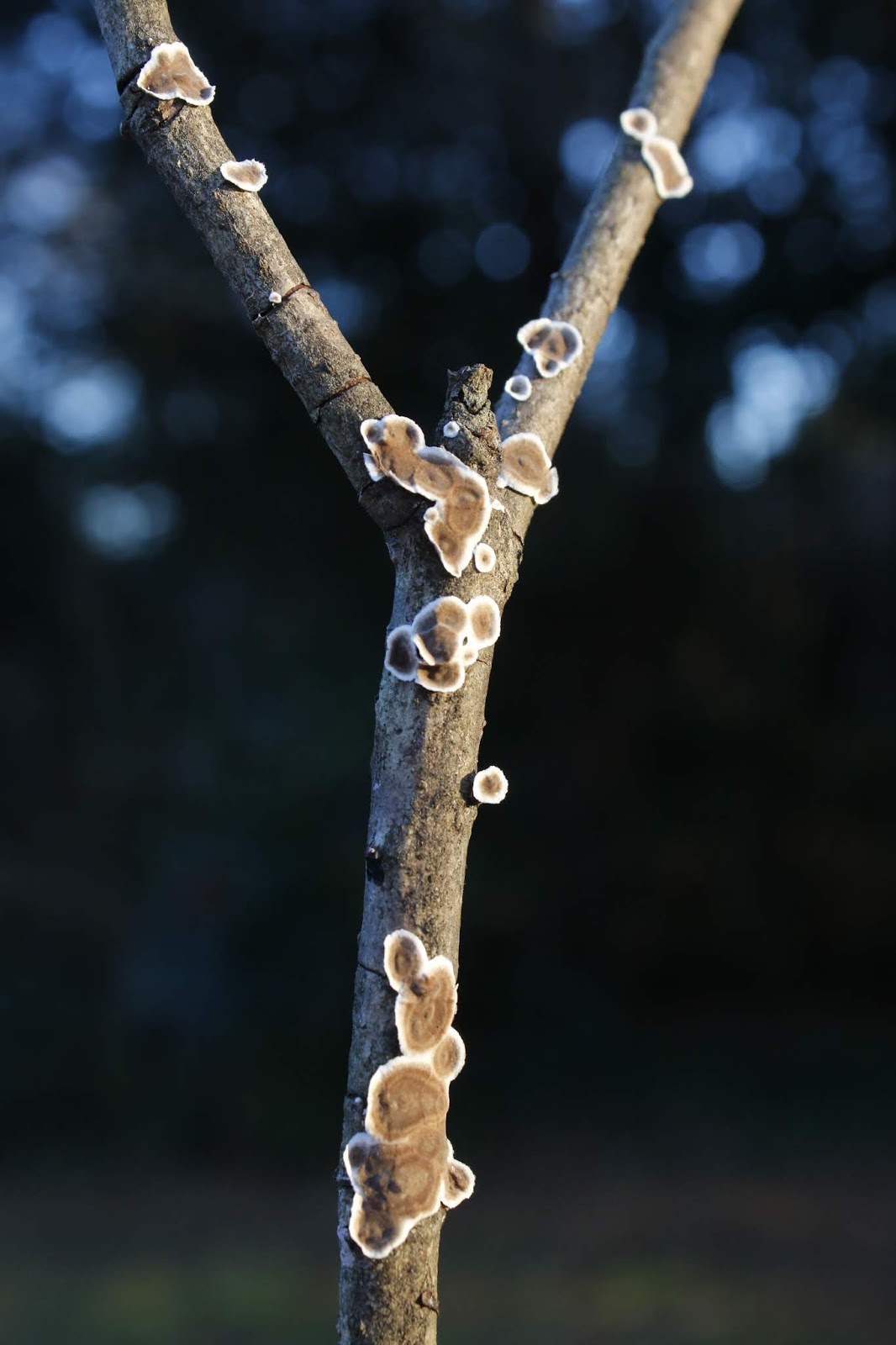
Fruiting bodies of Giraffe spots 
Peniophora albobadia
I am on a mycological kick so I will keep kicking.  Diane and I found a couple more interesting fungi growing on dead sticks recently. 

The first is giraffe spots Peniophora albobadia.  What you see with giraffe spots is really the fruiting body, the spore producing structure, growing tightly appressed to the stick.  Most of the fungus is the hyphae that are rotting the dead wood from the inside.  The fruiting body of this crust fungus is flat and brown with white margins.  This fungus often grows in groups and as the name suggests look like the pattern of spots on giraffes.  Giraffe spots is an important decomposer but is also a pathogen on peaches, nectarines and apricots. 


Giraffe coat pattern
Petr Kratochvil 
(publicdomainpictures.net)
Giraffe spots Peniophora albobadia
detail showing pattern


The second nice fungus was growing on a dead limb of the ornamental plant photinia.  This shelf fungus is a polypore with light and dark rings on the top of the fruiting body.  On the underside of the cap there are many pores (naturally) arranged in a labyrinthine pattern.  The scientific name of this fungus Daedalea quercina is quite apt.  The specific name, quercina, refers to the genus of oak, Quercus.  

Daedalea quercina showing the top of
the fruiting body with alternating light and dark rings
Daedalea quercina showing the underside of the
fruiting body with its labyrinthine pores
Our specimen was not growing on oak but this fungus is common on dead branches of that tree. The genus name Daedalea goes back to Greek mythology, named for Daedalus who built the Labyrinth for King Minos of Crete.  In the Labyrinth was imprisoned the Minotaur, a monster who ate sacrificial Athenian children.  The pores on this fungus, with their twisting chambers and passages could be a maze from which escape is futile.