 |
Carolina Sphinx Moth (Manduca sexta) hovering
over the flower of Sacred Datura (Datura wrightii).
The moth's proboscis is extended toward the flower.
Rowan County, North Carolina. |
This is a
story of the integration of three lives.
The sphinx is a giant moth whose caterpillar is a major agricultural
pest. The weed is Jimsonweed is a
handsome plant with large showy flowers and produces hallucinogenic
compounds. The parasite is a wasp that
lays its eggs in the larva of the Sphinx and new wasps burst forth like aliens
from the chest of an unfortunate sci-fi character.
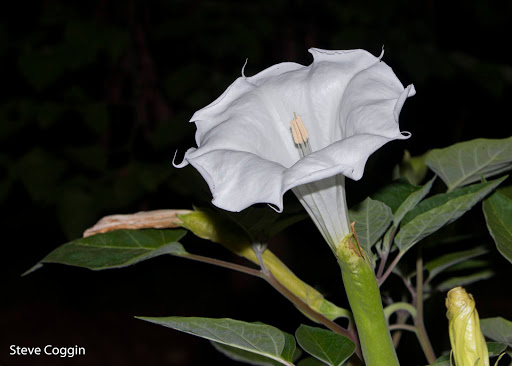 |
Sacred Datura plant flowering at night.
Rowan County, North Carolina. |
First the weed, Jimsonweed. It goes by many names. Its scientific name is Datura wrightii, also known as Sacred Datura and it is native to the Southewestern
United States and Mexico. We have several
plants in our yard that came to us by way of Austin, Texas.
There are several Jimsonweed species and they are in the same family as
potato, the Solanaceae. This interesting
and important plant family includes other well-known plants like Tomato, Tobacco,
Eggplant, Pepper and Deadly Nightshade.
Sacred
Datura is a desert plant with large gray-green leaves and, as expected from a desert
plant, is quite drought tolerant. It
produces a variety of toxic alkaloids that when consumed can induce profuse sweating,
drowsiness, visual impairment, hallucinations, psychosis and even death. The sacred in the name comes
from its use in religious ceremonies of native people in the desert Southwest and Northern Mexico. One
of the active compounds in Sacred Datura is scopolamine, a drug now used to
combat motion sickness, usually in the form of a transdermal patch. In the bad old days of spies and enhanced interrogation, scopolamine was a major ingredient in “truth serum” although its
effectiveness is questionable.
 |
Early and nearly mature flower buds of Sacred Datura.
Rowan County, North Carolina. |
 |
Sacred Datura flower on the afternoon the
flower will open.
Rowan County, North Carolina. |
 |
Sacred Datura petals on a flower that is about to open.
Rowan County. North Carolina. |
Jimsonweed
produces abundant, large, white, trumpet-shaped flowers throughout the summer. The flower shape and color give this plant
another of its many common names, Angel Trumpet. The flowers develop for several days, with
the petals rolled up within the green sepals.
Each day the flower gets longer and finally on flowering day the petals emerge and turn white. In late afternoon, the flowers open to show
the five petals fused that make the trumpet.
As evening comes, the flowers release a strong and pleasant
fragrance reminiscent of gardenia. The
white color and fragrance gives a clue to what Sacred Datura is doing at
night. The plant is sending an
unmistakable signal to its pollinator, the Carolina Sphinx Moth (Manduca sexta).
 |
Carolina Sphinx Moth about to feed.
Rowan County, North Carolina. |
 |
Carolina Sphinx Moth sipping nectar from a Sacred Datura flower.
The moth's long proboscis is visible reaching into the flower.
Rowan County, North Carolina. |
 |
Carolina Sphinx Moth approaching a Sacred Datura flower.
Rowan County, North Carolina. |
Carolina
Sphinx Moth has a four-inch wingspan, is dark gray in color and has five
paired, orange spots on the sides of its abdomen. The moth also has a long proboscis, a feeding
structure that can be over eight inches long.
The proboscis is the key to the moth’s relationship with the
Jimsonweed. Datura lures the moth in
from a distance with is fragrance, gives a visual target with the white flowers. The payoff for the moth is the sugar-rich nectar. The nectaries for the flower are at the base
of the trumpet-shaped tube, eight inches down.
The Carolina Sphinx Moth hovers over and even flies into the flower to
collect the nectar. But collecting nectar is
not straightforward. In order to drink,
the moth must thread its proboscis down one of five nectar tubes on
the inside of the petals.
Infrared video of Carolina Sphinx Moth feeding on Sacred Datura.
Rowan County, North Carolina.
More infrared video of Carolina Sphinx Moth feeding on Sacred Datura.
Rowan County, North Carolina.
While
collecting nectar, the moth brushes against the stamens of the flower picking up
pollen. It then flies to another flower
and transfers pollen to the female stigma.
There the pollen makes a tube that grows through the stigma, down the
style to the ovary at the bottom of the flower.
There the pollen nucleus fuses with the Datura egg. The fertilized egg and surrounding tissue
develops into the seed that is contained in the fruit. The fruit of Sacred Datura is covered with
spines and these give the plant yet another common name, Thornapple.
 |
Sacred Datura the day after flowering.
Rowan County, North Carolina. |
 |
Sacred Datura flower two days after flowering.
The sepals and petals have fallen off but the long
style and stigma are still attached to
the developing fruit.
Rowan County, North Carolina. |
 |
The spiny fruit of Sacred Datura showing why another common
name for the plant is Thornapple.
Rowan County, North Carolina. |
 |
Mature fruit of Sacred Datura. The fruit has broken open
and the seeds are visible.
Rowan County, North Carolina. |
The Carolina
Sphinx Moth comes from a large caterpillar called the Tobacco Hornworm. This larval stage eats, as the name suggests, tobacco but also thrives on other plants in the same family, including tomato. A female moth lays an egg on the host plant where
the larva grows and molts several times. The final larval stage of Carolina
Sphinx Moth is over three inches long and can quickly defoliate the host plant.
 |
Tobacco Hornworm is the caterpillar of Carolina Sphinx Moth.
This caterpillar is on a Tomato (Solanum lycopersicum) and is eating leaves.
The white structures are cocoons of the wasp Cotesia congregate
that has parasitized the caterpillar.
Rowan County, North Carolina.
|
This is
where the final part of the story comes in, the parasite. Actually, it is a parasitoid wasp, Cotesia congregate, that injects its eggs inside the body of the Tobacco
Hornworm caterpillar. The wasp eggs
hatch and the emergent larvae consume the caterpillar from within. Two weeks later wasp larvae dissolve their
way through the exoskeleton of the caterpillar and make a white cocoon on the
outside. Within the cocoon, the wasps metamorphose into their flying form. These wasps mate and parasitize more Tobacco Hornworms. A caterpillar parasitized by Cotesia
dies before it can transform into a moth so the wasp is an effective form of biological
control for Tobacco Hornworm.
This intricate relationship, this perfection of interaction, between
the plant, the moth and the wasp has been honed for millennia by evolution. Sacred
Datura attracts and feeds the Carolina Sphinx Moth. The moth has the sensory system specialized to find the
plant at night and a proboscis long enough to reach the nectar supply deep within
the flower. The moth then pollinates the
Datura plant. The wasp Cotesia parasitizes the Tobacco Hornworm to propagate the species. All the
interactions are pieces of an elaborate living puzzle.
POST SCRIPT - About two weeks after posting this blog I noticed the leaves of one of the Datura's were being eaten. Sure enough, several larvae of Tobacco Hornworm were consuming the leaves.
 |
The leaves of this Sacred Datura have been eaten.
Rowan County, North Carolina. |
The Carolina Sphinx moths were not only collecting nectar and pollinating the flowers but were also laying eggs on the leaves. Although it probably does not, this moth can complete its entire life cycle on one plant.
 |
The Datura leaves were being eaten by several Tobacco Hornworms,
the larvae of the Carolina Sphinx Moth. Note this caterpillar has not been parasitized
by the Cotesia wasp and is very healthy, measuring in at 3.5 inches. |


