Tuesday, November 15, 2022

Skulkers

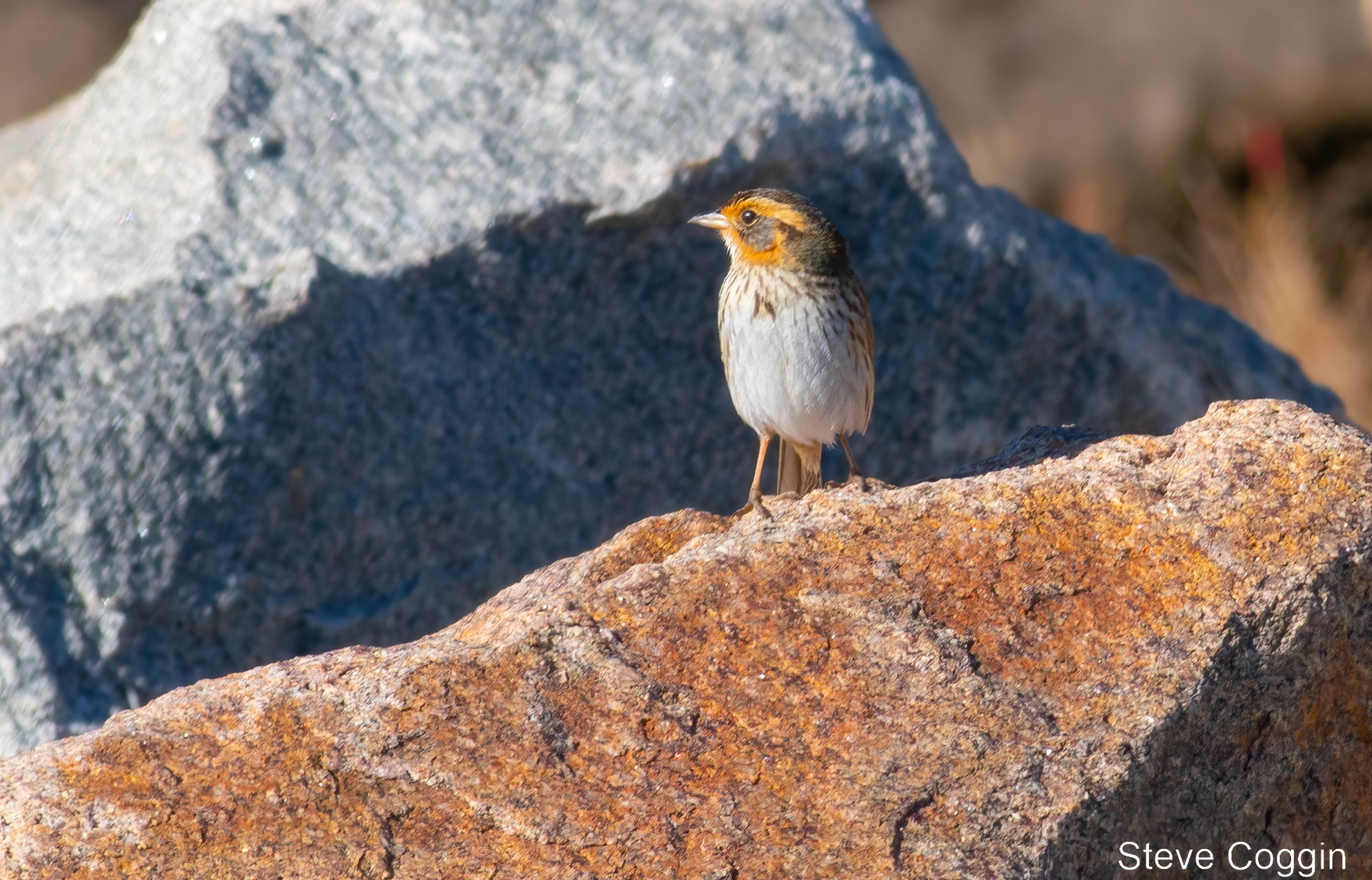
Seaside Sparrow (Ammodramus maritimus).  
Huntington Beach State Park, South Carolina.
 

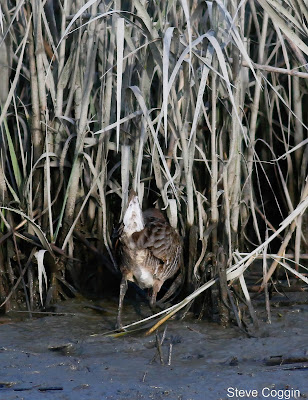
Some birds are really hard to see.  They are camouflaged and blend into their environment, They may live in dense vegetation and only pop out briefly, or they might just be really shy.  As difficult as these skulkers are to see, it is even more difficult to get a decent photo.  In this post I will share some observations of these skulking birds. 

Brown Creeper (Certhia americana).
Rowan County, North Carolina. 

Brown Creepers (Certhia americana) are tiny birds that catch insects on tree trunks.  They winter in the Southeastern United States, arriving in October and flying north to breed in the spring.  Brown Creepers have a small curved beak, beady little eyes and plumage in many shades of brown with a dappling of white.  This pattern makes them disappear into the background of the tree trunk. One cold winter day I plunked a lawn chair down in our front yard and watched a maple tree that a Creeper would sometimes visit.  After a cold half hour, a Brown Creeper flew to the bottom of the tree and began spiraling up the trunk.  The bird saw me and shyly disappeared around the back of the tree.     

Brown Creeper.
Rowan County, North Carolina.

The Family Caprimulgidae are an interesting group of birds with a bizarre common name. This group  is called Goatsuckers or Nightjars and includes Nighthawks as well as other birds. These nocturnal flyers catch insects on the wing, scooping them up in their wide mouths.  Those big mouths give them the common name Goatsuckers.  An ancient superstition says these birds suck milk from the teats of female goats.  This of course does not happen but the tradition lives on in their strange name.  While Goatsuckers fly at night, during the day they rest on the ground or tree limbs, perfectly camouflaged with their mottled feathers.  Finding one of these birds sleeping is a rare event and involves a great deal of luck. Good luck broke upon us one day in south Texas.  Two Common Pauraques (Nyctidromus albicollis) were dozing in a thicket.  Our guide pointed to the spot six feet away and said "These will be the closest life birds you will ever have a hard time seeing".  We spent a long time staring into the brush before finally seeing the birds. 

Common Pauraque (Nyctidromus ablicollis).
Estero Llano Grande State Park, Texas. 

I had a similar experience in Florida.  A couple of people with binoculars and cameras were staring into a bush next to trail at the Loxahatchee National Wildlife Refuge.  These birders told me a Chuck-will’s-widow (Antrostomus carolinensis) was in there.  So cryptic was this skulker I had to strain my eyes for minutes to pick out the bird. 

Chuck-will's-widow (Antrostomus carolinensis).
Loxahatchee National Wildlife Refuge, Florida. 

While some wading birds like Great Egrets (Ardea alba) or Roseate Spoonbills (Platalea ajaja) are hard to miss, Bitterns are hard to see.  They stand still among the cattails and other marsh plants and blend right in, so it is a treat to get a good look at them.  American Bitterns (Botaurus lentiginosus) and Least Bitterns (Ixobrychus exilis) both live in the Southeast for some of the year.  We usually get fleeting glimpses of these Bitterns in the marshes of Florida.  The American Bittern is the larger of the two and is brown with vertical stripes, mimicking the pattern of the marsh grasses where it hunts fish and other small animals. 

American Bittern (Botaurus lentiginosus)
Green Cay Wetlands, Palm Beach County, Florida. 

American Bittern.
Green Cay Wetlands, Palm Beach County, Florida.

The Least Bittern is half the size of the American Bittern with a short neck and the males have a black crown and back.    

Least Bittern (Ixobrychus exilis).
Wakodahatchee Wetlands, Palm Beach County, Florida.

Least Bittern.
Wakodahatchee Wetlands, Palm Beach County, Florida. 

Saltmarshes along the Atlantic coast host several hard to see sparrows.  Seaside Sparrows (Ammodramus maritinmus) live in tidal marshes from New England south to Florida and around the Gulf Coast into Mexico.  These sparrows are brown with streaks on the breast, a pointed bill and a yellow spot between the beak and the eye.   Their coloration makes them difficult to see unless they perch on the top of the marsh grass. Huntington Beach State Park in South Carolina has extensive saltmarshes and when we visit in fall or winter these sparrows are a special attraction.  Sometimes they are only a brown flash above the Spartina (Spartina alterniflora) marsh grass. But sometimes they perch on top of the grass or light on the rocks at the marsh’s edge and give us a really good look. 

Seaside Sparrow.
Huntington Beach State Park, South Carolina.

Seaside Sparrow.
Huntington Beach State Park, South Carolina.

Saltmarsh Sparrows (Ammondramus caudacutus) have buffy orange on the face with a gray cheek patch and fine stripes on the upper breast. They are found in these same marshes and have much the same behavior as the Seaside Sparrows.  Saltmarsh Sparrows feed on grass seeds and with their strict habitat requirement of saltmarshes they are threatened by sea level rise driven by climate change.   

Saltmarsh Sparrow (Ammodramus caudacutus).
Huntington Beach State Park, South Carolina.

Saltmarsh Sparrow.
Huntington Beach State Park, South Carolina. 

I think Rails (Family Rallidae) are the ultimate skulkers.  Thirteen species of these chicken-like birds inhabit marshes throughout North America.  Rails slip between the marsh plants and it is rare to get a long look.  Virginia Rails (Rallus limicola) live in both fresh and salt marshes.  They breed in the northern and western United States and southern Canada. Most migrate south for the winter and we ran into a cooperative Virginia Rail at a pond in the Lower Rio Grande Valley of Texas.  This Virginia Rail strolled from the cattails for a few seconds and quietly disappeared again.  

Virginia Rail (Rallus limicola).
Lake Casa Blanca International State Park, Texas.

Sora (Porzana carolina) is another species of small rail with a short, yellow bill, black face and barring below.  They breed in fresh and brackish marshes in the north and west and migrate south for the winter.  Occasionally we run across Soras in the Florida marshes as they creep out of the vegetation and then disappear.  

Sora (Porzana carolina).
Green Cay Wetlands, Palm Beach County, Florida. 

Clapper Rails (Rallus crepitans) are larger than Soras and Virginia Rails and are denizens of salt marshes from New England to California and Mexico.  Clapper Rails have a long, curved bill, a ruddy breast and barring from the belly to below the tail.  Clapper Rails are more often heard than seen.  They give a loud kek-kek-kek call that booms across the marsh and resembles clapping.  Sometimes Clapper Rails respond with their call to people clapping.  Clapper Rails are common in the marshes of Huntington Beach State Park.  We hear them calling and if we are lucky, see them walking along the edge of a tidal creek before vanishing into the Spartina marsh. 

Clapper Rail (Rallus crepitans).
Huntington Beach State Park, South Carolina.

A Clapper Rail disappearing into the marsh grass.
Huntington Beach State Park, South Carolina. 

All these birds can appear and disappear with surprising ease.  They are a real challenge to birders whether they are beginners or old pros.  Their cryptic coloration and shy habits allow them to skulk through the world.

Clapper Rail.
Huntington Beach State Park, South Carolina.

Tuesday, November 1, 2022

Amanita: Destroying Angels, Fly Poisons and Hallucinations


Fly Agaric (Amanita muscaria) growing
beneath oak (Quercus).
Rowan County, North Carolina. 

Amanita is a large genus of Basidiomycete fungi.  The Basidiomycetes include mushrooms, puffballs and even a few yeasts.  The members of the genus Amanita usually make connections with the roots of trees in a symbiotic, mycorrhizal association.  Amanita mushrooms begin their development with a small, round, egg-like structure called the volva.  The stalk lengthens and the bottom of the volva stays in the soil as a cup.  The top of the volva is carried on the top of the cap where, in some species, it forms white patches called warts. The gills on the underside of the cap make the spores and are initially covered by a layer of tissue called the veil.  The remains of the veil are often attached to the stalk of the mushroom at maturity. Some Amanitas are delicious mushrooms while others are hallucinogenic or even deadly.  

If you ask a child to draw a mushroom, they would most likely make a picture of Amanita muscaria, with a red cap, white warts and a white stalk.   The graphic appearance of this mushroom has caused it to show up as a home for Smurfs and as the mushroom-headed character Toad in the Mario video games by Nintendo.   

The real-life Amanita muscaria is even more interesting.  The cap of Amanita muscaria can range in color from deep red to orange to yellow.  It grows throughout the northern hemisphere and is associated with many trees, including pines and oaks.  The common name for this mushroom, Fly Agaric, refers to its use as an insect poison.  In past centuries, people in Europe would grind the mushroom and place it in milk.  Flies that drank the milk would be killed by toxins from the mushroom.  This use of the mushroom was so well know that the specific name, muscaria, is derived from the Latin, musca, for fly.  

Amanita muscaria with a yellow-orange cap and white warts.
Rowan County, North Carolina. 

Amanita muscaria contains the toxins ibotenic acid, muscimol and muscarine.  These compounds are similar in structure to a neurotransmitter, gamma amino butyric acid, that is found in the central nervous system of animals.  Within minutes of ingestion, people experience vomiting, agitation and visual or auditory hallucinations.  Despite these significant effects, the mushroom rarely causes death.  Fly Agaric has been used in many places around the world in religious rituals.  Shamans in some Siberian cultures would ingest Amanita muscaria and experience visions.  The psychoactive compounds in Fly Agaric were secreted in their urine and people would drink the shaman’s urine to share in his altered state of conciseness.  

Amanita gemmata.
Rowan County, North Carolina.

Amanita gemmata is widely distributed in both the Old and New Worlds.  The mushroom has a yellow-brown cap and sometimes has white warts.  Amanita gemmata contains ibotenic acid and muscimol, as does Amanita muscaria, so it is also most likely psychoactive. 

Amanita bisporigera growing under Live Oak
(Quercus virginiana). This deadly mushroom is
also know as the Destroying Angel.
Palm Beach County, Florida. 

Amanita bisporigera showing the basal cup
and ring of the veil below the cap.
Palm Beach County, Florida.

Amanita bisporigera is a deadly mushroom with the impressive common name, Destroying Angel. This white mushroom is found in Eastern North America grows in mixed coniferous and deciduous forests.  Destroying Angel mushrooms contain a group of poisons called amatoxins.  These small peptides inhibit RNA synthesis and cause liver failure, kidney failure and possibly death.  Amanita bisporigera also contains another type of poison, phallotoxins, that disrupt cell structure and function. A single cap of Destroying Angel contains enough of these toxins to kill and adult.  Typically, a person ingesting Amanita bisporigera reports the mushroom has a pleasant flavor and they present no symptoms for about 12 hours.  Then nausea, vomiting and diarrhea begins and if untreated, proceeds to complete kidney and liver shut down, coma and death.  Treatment usually involves having the victim drink activated charcoal to absorb the toxins.  Some patients undergo transfusion and even liver transplant to save them from this mushroom.  With these aggressive treatments mortality for Amanita bisporigera poisoning has been lowered to 27%.

Early stage of the Destroying Angel mushroom
growing on a lawn beneath oaks.
Rowan County, North Carolina. 

Destroying Angel with the cup visible at the base.
Rowan County, North Carolina. 

Mature Destroying Angel showing the veil on the stalk.
Rowan County, North Carolina. 

The classification of  Amanita is complex and in flux.  Identifying these mushrooms is difficult because the names of species have changed many times based on new research.  There is DNA evidence that Amanita muscaria in North America may actually be 8 different species. Identification of these well know mushrooms is problematic, even for experts.  This reinforces the notion that you should never eat a mushroom from the wild unless you are certain of its identity.  The result of an error could be deadly.


Saturday, October 15, 2022

The DYCs of Autumn


Tick Seed (Bidens aristosa).  One flower is being pollinated
by a bee-mimic Hover Fly (Syrphidae). 
Rowan County, North Carolina. 

In spring the palette of wildflower color runs toward blue and purple, but as summer eases into fall the predominate flower color is yellow.  Many of these yellow blooms are sported by members of the Composite family, the Asteraceae.  This large family includes many familiar plants like sunflowers, asters, daisies and dandelions.    Many of the fall Composites look similar and are difficult to tell apart. Some folks call then DYCs, Damn Yellow Composites.  

Composite is no longer the accepted name of the family Asteraceae but is descriptive.  What looks like a flower in many Composites is actually a group of flowers, an inflorescence.  Many inflorescences of the Asteraceae are a composite of two distinct types of flowers, disk flowers and ray flowers.  Take a sunflower for example; the outer edge that appears to be petals is really a group of ray flowers and in the center are hundreds of disk flowers. This display looks like a single giant flower to insects that pollinate the plant. 

Here is a collection of DYCs of autumn we see in our little slice of North Carolina.  

Smallanthus uvedalia, Bear’s Foot is an impressive plant.  It has large lobed leaves that resemble a bear’s paw.  This tall plant blooms in late summer and fall with an inflorescence of yellow ray and disk flowers.  

Bear Paw, Smallanthus uvedalia, with its large leaves and yellow
flowers, blooming by a stream.
Mecklenburg County, North Carolina. 

Another tall DYC is Wingstem (Verbesnia alternifolia).  It also has yellow ray and disk flowers but the disk flowers are sparse and that gives the inflorescence an unkempt look. As the common name suggests, the stems of the plant has ridges that look like wings running down their length.  Wingstem usually grows along the sunny edges of streams. 

Verbesnia alternifolila, Wingstem, has yellow ray and disk
flowers.  The stems are winged.  This one is being
pollinated by a Scolid Wasp, Scolia dubia.
Rowan County, North Carolina. 

Wings on the stem of Wingstem.
Rowan County, North Carolina. 

Tickseed, Bidens aristosa, grows in open fields and edges of woods.  This is another plant with yellow ray and disk flowers.  The fruits of Tickseed have two prongs and attach to passing animals or the pants of hikers, spreading the plant. 

Tick Seed flowers.
Rowan County, North Carolina. 

Tick Seed Fruit.
Rowan County, North Carolina. 

Bidens bipinnata is a close relative of Tickseed with the common name Spanish Needles.  It has deeply dissected leaves and makes small inflorescences with just a few yellow ray flowers.   The fruits are long with prongs at the end and are dispersed by animals in much the same way as Tickseed. 

Spanish Needles (Bidens bipinnata).
Henderson County, North Carolina. 

Purple Sneezeweed (Helenium flexuosum) has yellow ray flowers and purple-brown disk flowers.  The ray flowers are tipped with three lobes.  The leaves and flowers of this plant were once dried and ground into snuff, giving rise to its common name.  

Purple Sneezeweed (Helenium flexosum).  This DYC has
yellow ray flowers and brownish purple disk flowers.
Henderson County, North Carolina. 

The most emblematic DYC of autumn is Goldenrod (Solidago sp.).  There are over 30 species of Goldenrod in our area and plants fill the fields and line the roadsides with their yellow flowers in fall.  Goldenrod makes numerous, small inflorescences containing both ray and disk flowers.  These are arranged along the tips of stems making sprays of gold.  

A field of Goldenrod (Solidago sp.). 
Rowan County, North Carolina. 

Closeup of the yellow ray and disk flowers of Goldenrod.
Rowan County, North Carolina.  

Fall is flying by and the DYCs are starting to fade.  But amateur botanists everywhere look forward and dread the coming of autumn and the reappearance of these challenging yellow flowers. 

Tick Seed flowers.
Rowan County, North Carolina. 

Saturday, October 1, 2022

The Pond Apple and the Reptiles


Green Iguana (Iguana iguana).
Green Cay Wetlands, Palm Beach County, Florida.

Pond Apples are fruits made by the Pond Apple tree (Annona glabra).  This tree is native to Florida, the American tropics and west Africa.  True to the name, Pond Apples grow in swamps, beside lakes, along rivers and, yes, on the margins of ponds.  Pond Apple trees are sensitive to cold and South Florida is the northern limit of their range in the North America.  There was once a large forest of Pond Apples on the southern shore of Lake Okeechobee. This forest was lost with the coming of drainage canals and farms to that area.  Pond Apple trees are favored nest sites for many wading birds in Florida.  Wakodahatchee Wetlands in Palm Beach County has a large stand of Pond Apple trees that host nesting Wood Storks (Mycteria americana) and other impressive waders.  

Wood Storks (Mycteria americana
 nesting in a Pond Apple tree (Annona glabra).
Wakodahatchee Wetlands, Palm Beach County, Florida.  

Pond Apple trees produce pale flowers in spring.  The flower develops into the apple that grows throughout the summer, changing from green to yellow.  The apples are 3-4 inches in diameter and look very much like the apples we eat.    

Pond Apple (Annona glabra) flower bud.
Wakodahatchee Wetlands, Palm Beach County, Florida.

A young Pond Apple.
Wakodahatchee Wetlands, Florida. 

When ripe, the apples fall from the tree, often into water where they float.  The main way Pond Apple disperses it seeds is with its floating fruits.  The fruit can float for weeks and the seeds can even survive salt water immersion.  Pond Apples fruits probably floated across the Atlantic from South America to colonize Africa.

Mature Pond Apple fruit.
Wakodahatchee Wetlands, Palm Beach County, Florida.

Pond Apple fruits are edible, with yellow flesh and a mild taste.  But the seeds are poisonous and their extracts were used as a fish poison by Native Americans. Pond Apple is important in traditional medicine and has been used to treat a variety of aliments including tubercular cough, intestinal worms and diarrhea.

American Alligator (Alligator mississippiensis).
This gator is hunting Pond Apples.
Green Cay Wetlands, Palm Beach County, Florida. 

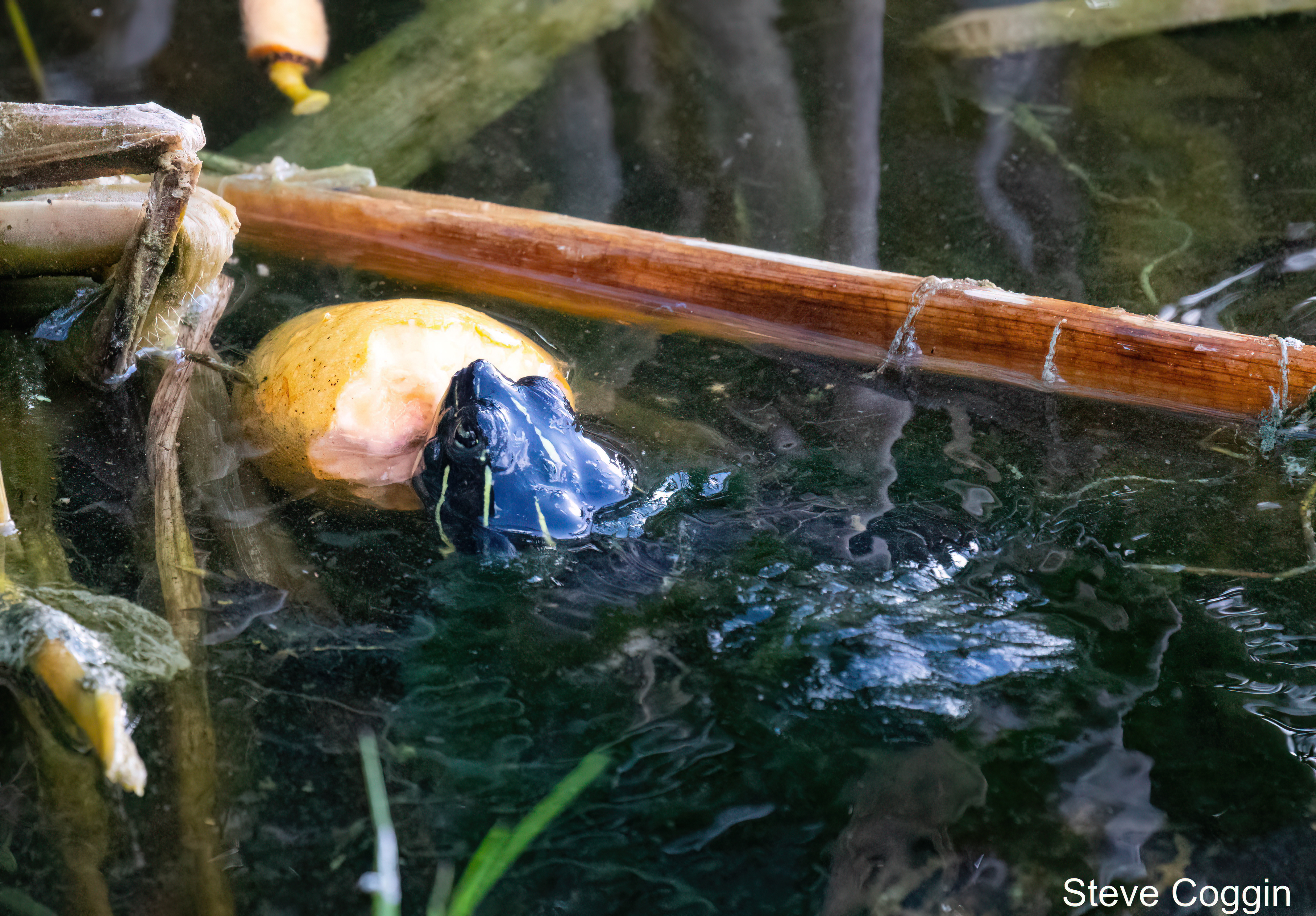
American Alligators relish these fruits and another name for Pond Apple is Alligator Apple.  On a recent visit to Florida, we saw a Florida Red-bellied Cooter (Pseudemys nelsoni) eating a floating apple.  The turtle would push the fruit around until it was trapped by vegetation, then take a bite.  We also saw a pack of Green Iguanas (Iguana iguana) eating a Pond Apple that fell onto dry land.  I am not sure how these reptiles handle the toxic seeds but they were not spitting them out.    
 
Florida Red-bellied Cooter (Pseudemys nelsoni)
eating a floating Pond Apple. 
Wakodahatchee Wetlands, Palm Beach County, Florida. 

             
Video of a Florida Red-bellied Cooter eating a Pond Apple.
Wakodahatchee Wetlands, Palm Beach County, Florida. 

Green Iguanas feasting on a Pond Apple.
Wakodahatchee Wetlands, Palm Beach County, Florida.

Pond Apples thrive in south Florida and other tropical areas.  The fruits and the trees are salt tolerant so they are better equipped than many plants for climate change induced sea-level rise.  Pond Apples will continue thrive in Florida and feed the reptiles. 


Thursday, September 15, 2022

Passionflowers


Flower of Passiflora incarnata, the Purple Passionflower.
Rowan County, North Carolina. 

Passionflower flowers are as beautiful as they are complex.  They are classified in the genus Passiflora, a group of plants found mainly in the neotropics which is home for more than 500 species of passionflowers.  Two passionflowers are found in the Southeastern United States, Purple Passionflower, Passiflora incarnata and Yellow Passionflower, Passiflora lutea

The flowers have five sepals and five petals that are similar in shape and color.  Above the sepals and petals is a ring of long filaments called the corona. Arching from the center of the flower over the corona are five, pollen producing, stamens.  Then above the stamens are the carpels with three stigmas, the female flower parts that receive pollen. 

This striking flower structure caught the attention of early Spanish missionaries in the New World.  To these holy men, the flower was telling the story of the passion of Jesus. The five sepals and petals represented the ten faithful disciples.  Judas was left out for betraying Jesus and St. Peter; the founder of the Catholic Church, was not represented by a sepal or a petal because he denied Jesus on the night of his arrest.  The corona of filaments stood for the crown of thorns, the five stamens for Jesus's wounds on the cross and the three stigmas represented the three nails used in the crucifixion.  This religious interpretation of floral structure is how the plants got their name. 

Flower bud of Purple Passionflower.
Rowan County, North Carolina.

Purple Passionflower bud opening.
Rowan County, North Carolina. 

Purple Passionflower bud as it opens showing sepals,
petals and filaments of the corona. 
Rowan County, North Carolina. 
        
Fully open Purple Passionflower.
Rowan County, North Carolina.

Passiflora incarnata, the Purple Passionflower, is an herbaceous vine with three-lobed leaves.  The plant can ramble across the ground and produce tendrils that allow it to grow over other plants.  As its name suggests, the flower has purple sepals and petals.  The filaments are banded with purple and white while the stamens and carpels are yellow-green.  Passionflowers are pollinated by bees and develop large, green edible fruits.   

Three-lobed leaf of Purple Passionflower.
Rowan County, North Carolina. 

A Carpenter Bee (Xylocopa sp.) pollinating Purple Passionflower. 
The bee is collecting nectar as a stamen of the flower
 is depositing pollen on its back. 
Rowan County, North Carolina.

Two Purple Passionflower fruits. 
Rowan County, North Carolina. 

Yellow Passionflower (Passiflora lutea) is the second species in our area. Like Purple Passionflower, Yellow Passionflower is also a vine and its leaves have three lobes.  Yellow Passionflower is not as showy as the Purple Passionflower and has small yellow flowers.  But these flowers have the same complex structures as Purple Passionflower.  

Yellow Passionflower (Passiflora lutea) with its
rounded, three-lobed leaves and small yellow flower.
Rowan County, North Carolina. 

Yellow Passionflower has the same flower structure as its
more colorful relative, the Purple Passionflower.
Rowan County, North Carolina. 

Passionflower is the host of Gulf Fritillary butterflies (Agraulis vanillae).  These beautiful butterflies lay their eggs on the leaves of Passionflowers.  The eggs hatch and the larvae eat the leaves and transform into a chrysalis that hangs on the stems.  After a few weeks the adult butterfly emerges and feeds on the nectar of many plant species.  The bright orange color of the Gulf Fritillary is advertising its unpalatability.  Predators avoid this butterfly because it contains noxious chemicals that the larvae collected while eating Passionflower leaves.  Even the caterpillars of Gulf Fritillary advertise their toxicity with their bright orange color and black spikes. 

Gulf Fritillary (Agraulis vanillae) caterpillar on Purple Passionflower.
Rowan County, North Carolina. 

Passionflowers thrive in the hottest summer months. Even in the midst of a drought they bring on the those great flowers. So while many plants are riding out the heat, passionflowers put on their show.

Adult Gulf Fritillary.
Rowan County, North Carolina.