Saturday, April 15, 2023

Lycopodium


Dendrolycopodium obscurum (Common Tree Club Moss).
A Lycopodium growing in
Rowan County, North Carolina. 

Lycopodium, or club moss, is not a moss at all but a seedless vascular plant. It belongs to an ancient lineage with its origin in the Devonian Period, over 400 million years ago.  Lycopodium was an early land plant and predated the dinosaurs.  Today’s club mosses are small plants but during the Carboniferous Period some Lycopodium relatives were giant trees. Coal deposits in the Appalachian Mountains contain the remains of Lycopodium that reached heights of over 100 feet.  

Lycopodium reproduces by spores made in sporangia that are shaped like clubs (thus the name club moss) and extend above the branched stems.  These stems bear tiny leaves that carry out photosynthesis.  

The genus Lycopodium formerly had 10 species in the Carolinas.  New research has broken that genus up into 7 genera and about 13 species.  I will use the name Lycopodium to refer to this group but use the currently accepted scientific name for each species in the blog. 


Dendrolycopodium obscurum with sporangia.
Rowan County, North Carolina. 

Dendrolycopodium obscurum, Common Tree Club Moss, is a small plant of the forest understory.  It has horizontally spreading branches that resemble tiny trees.  The upright plants we see are produced from an underground stem, a rhizome. Common Tree Club Moss is often seen in large stands or in a line all coming from a rhizome.   


A line of Dendrolycopodium obscuru from an underground rhizome. 
Rowan County, North Carolina. 

Lycopodiella alopecuroides, Foxtail Club Moss, grows along the ground with branching stems. This species grows in the wet, sandy soil of pine savannas on the Coastal Plain of the Carolinas. 


Lycopodiella alopecuroides, Foxtail Club Moss.
Wake County, North Carolina.  

Foxtail Club Moss with branching stems.
Wake County, North Carolina. 

Lycopodium reproduces by spores. These spores have interesting characteristics and some bizarre uses.  The spores are tiny, about 35 micrometers in diameter, and easily float on the air.  Plants release spores that are carried on the breeze, settle to the ground and establish new plants.   But if large numbers of Lycopodium spores are lofted into the air, they are highly flammable and even explosive.  The spores have a high wax content and a huge surface area.  This allows them to rapidly burn.  Lycopodium spores were used in the earliest flash photography.  Nineteenth century photographers would hold up a T-shaped tray filled with spores, squeeze a bulb to shoot the spores into the air and ignite them, giving a brief but brilliant flash to illuminate their subject.  Lycopodium spores have been used to produce theatrical stage flames and explosions.  In fact, Lycopodium spores are commonly called Dragon Breath by magicians who use it in their acts.  They were also used in Native American religious ceremonies. 


Danish-American photographer Jacob Riis using flash powder.
http://hspvaragtime.weebly.com/home/jacob-riis 


Video of flaming Lycopodium spores.
Rowan County, North Carolina. 

Lycopodium is a fascinating member of our flora.  The ancestors of these humble little plants were massive trees and their remains make up much of the coal we continue to burn and warm the planet.  When you see Lycopodium, think that long ago, it fed dinosaurs. 

A large stand of Dendrolycopodium obscurum.
Rowan County, North Carolina. 


Saturday, April 1, 2023

Warblers Part 2


 Western Palm Warbler (Setophaga palmarum) wintering in south Florida.
Palm Beach County, Florida. 

The American wood warblers, the Parulidae, are gems of the bird world.   When they return from the tropics in spring, their dazzling colors and brilliant songs light up the woods.  This blog continues with some warblers that breed in our area, others that pass through on migration and even an uncommon winter resident.  

A male Hooded Warbler (Setophaga citrina).
This bird stopped on a tiny island in the Gulf of Mexico
 to rest and drink at a pool during migration. 
Dry Tortugas National Park, Florida. 

Hooded Warblers (Setophaga citrina) are bright yellow on the face and breast.  Males have a black hood and females have a paler version of that hood.  They breed in the forests of the eastern United States and winter in south Florida and the American tropics 


A male Prairie Warbler (Setophaga discolor) on McDowell Prairie.
Mecklenburg County, North Carolina.  

Prairie Warblers (Setophaga discolor) are small warblers that nest in scrubby fields and forest edges in the eastern United States.  Prairies are yellow with a yellow semi-circle under the eyes and black streaks on the face and side.  These warblers often wag their tails as they hunt their insect prey.


A male Chestnut-sided Warbler (Setophaga pensylvanica)
on his breeding territory.
Ashe County, North Carolina. 


Chestnut-sided Warblers (Setophaga pensylvanica) pass through the Piedmont on migration from their wintering grounds in Central America.  They breed from the southern Appalachians to the forests of the northeast and Midwest.  In the mating season, male Chestnut-sided Warblers have a greenish-yellow crown, a black and white face, white breast and belly with a chestnut streak down each side.  Their song is friendly rendition of “Pleased, pleased, pleased to meetcha”.   


 A Yellow Palm Warbler on migration.
Mecklenburg County, North Carolina. 

Palm Warblers (Setphaga palmarum) only spend part of their year where palms live.  In summer they breed in the boreal forest and in winter they stay near the coast of the southeastern United States, islands of the Caribbean, Central America and a small population along the Pacific coast of the US.  The wintering range of Palm Warblers is moving north with climate change.  Palm Warblers have a rufous crown, yellow under the tail and brown streaks on the breast.  Palm Warblers bob their tails as they feed in bushes, low trees and on the ground.  


A Western Palm Warbler in winter.
Palm Beach County, Florida.  

There are two subspecies of Palm Warblers. The Western Palm Warbler is the duller of the two and breeds west of James Bay in Canada.  Western Palm Warblers migrate west of the Appalachian Mountains and many winter in the southeast while others move to the tropics.  The second subspecies, the Yellow Palm Warbler, breeds east of the James Bay, migrates east of the Appalachian Mountains, winters along the Gulf Coast and is bright yellow.    


A male Cape May Warbler (Setophaga tigrina) on migration.
Rowan County, North Carolina. 

Another warbler that breeds in the far north is the Cape May Warbler (Setophaga tigrina).  These brilliantly colored warblers have yellow on the face, throat and breast.  Cape Mays have an orange cheek patch and black streaks on the breast.  This warbler’s name comes from Cape May, New Jersey where it was first collected on its migration.  Cape May Warblers spend the winter in the West Indies and Central America. 

Canada Warbler (Cardellina canadensis) in fall.
Henderson County, North Carolina. 

Canada Warblers (Cardellina canadensis) do breed in Canada but also in the northeastern and upper Midwest of the US.  They also nest at higher altitudes of the Appalachian chain as far south as Georgia.  Canada Warblers winter in northern South America after the long and dangerous flight over the Gulf of Mexico and Caribbean Sea.  Canada Warblers are gray on the back and wings with a yellow throat and breast set off with a black necklace of streaks. 


Tennessee Warbler (Leiothlypis peregrina) on fall migration.
Rowan County, North Carolina. 

Another geographically named warbler is the Tennessee Warbler (Leiothlypis peregrina).  But these warblers only pass through that state whose name they bear on their way to breed.  They inhabit the same northern forests that host Canada Warblers, Cape May Warblers and Palm Warblers.  Tennessee Warblers spend the winter in Central and South America.  They are rather plain birds with a greenish back and wings, gray breast and a black eyeline.   


An Orange-crowned Warbler (Leiothlypis celata) wintering along the
 South Carolina coast. This birds shows a faint orange crown.
Myrtle Beach State Park, South Carolina.


Orange-crowned Warblers (Leiothlypis celata) are called the bird with no field marks.  They are very plain with an olive-yellow body, a faint eyeline and an orange crown that is seldom seen.   Orange- crowned Warblers nest from the Canadian Maritimes west to Alaska and down the Rocky Mountains as far south as Arizona and New Mexico.  They spend their winters in the southern United States, Mexico and Central America.


A first-year female Kirtland's Warbler (Setophaga kirtlandii) making
a brief stop in North Carolina on the way to the Bahamas.
Chatham County, North Carolina. 

The rarest of the warblers is the Kirtland’s Warbler (Setophaga kirtlandii).  Kirtland's are long-legged warblers with a broken white eye ring and a yellow breast and belly with bold black stripes. These warblers were nearly extinct by the late 20th century, but conservation efforts brought them back from the brink.  Historically, Kirtland’s warblers were found throughout the pine forests of the upper Midwest.  They inhabit young pine stands but their habitat was drastically reduced in the 19th and 20th centuries by logging and wildfire suppression.  In the late 20th century the range of Kirtland’s Warblers was reduced to a few counties in the Lower Peninsula of Michigan.  In 1974 researchers found only 167 singing males and it was declared endangered.  The Endangered Species Act provided funding for habitat improvement and reduction of Brown-headed Cowbird (Molothrus ater) populations.  Brown-headed Cowbirds are nest parasites that lay their eggs in the nests of other birds and dramatically reduce the reproduction of the parasitized species.  Kirtland’s Warblers are particularly susceptible to cowbird parasitism.  Through this extensive conservation effort the Kirtland’s Warbler population has grown to over 5000 and the bird has spread to the Upper Peninsula of Michigan, Wisconsin and Ontario.  The population success led the Kirtland’s Warbler to be removed from the Endangered Species List. Kirtland’s Warblers do not spend their entire year in Michigan.  After breeding the birds fly from the Midwest and Canada to the Bahamas.  Occasionally a Kirtland’s Warbler stops in North Carolina to refuel.  When that happens dozens, nay hundreds of birders turn out to get a look at this rarest of the warblers. 

Kirtland's Warbler.
Chatham County, North Carolina.

Despite the success of the Kirtland’s Warbler recovery, warblers in general are in trouble.  Nearly all the warblers discussed in this blog have seen a decrease in population over the last several decades.  There are many reasons for this decline.  Habitat loss and fragmentation of breeding grounds, migration routes and wintering areas all play a role.  Decline in insect populations due to pesticide use and farming practices have drastically reduced the warbler food supply.  Rachel Carson made an ominous prediction in her 1962 book Silent Spring.  She asked us to imagine a spring without the sound of bird song.  Her concern was DDT.  That pesticide was banned in the United States, but it is still used in South America. We have others poisons that took DDTs place in the US, so Carson’s fear is still with us.  I do not want to contemplate a silent spring. But there are small steps we can take.  Limiting pesticide use and using native plants for landscaping supports insect populations that feed the warblers.    


Wednesday, March 15, 2023

Warblers Part 1


Prothonotary Warbler (Protonotaria citrea).
Rowan County, North Carolina. 

Spring is coming and birds that spent the winter in the tropics are heading north.  The most eagerly awaited of these neotropical migrants are the new world warblers, the Parulidae. These small birds are active, often brightly colored and each sings a distinctive song.  This family has 117 species and all are restricted to the New World.  Many warblers are tropical but over 35 species regularly occur in eastern North America.   


Pine Warbler (Setphaga pinus).
Rowan County, North Carolina.

Pine Warblers (Setophaga pinus) are present year-round of the Piedmont of North Carolina.  As their name suggests they are closely associated with pines (Pinus sp.) where they feed, breed and nest.  Yellow-rumped Warblers (Setophaga coronata) migrate from the north and spend the cold months with us.  This species breeds in northern forests and winters throughout the south and into the tropics. Yes, Yellow-rumped Warblers do have yellow rumps. This gives rise to their nickname, butterbutts.


Male Yellow-rumped Warbler (Setophaga coronata) in spring.
Rowan County, North Carolina. 


Female Yellow-rumped Warlber in winter,
showing her yellow rump,
Rowan County, North Carolina. 

Other warblers arrive from the south in the spring and breed in our area.  One of the first of these early birds is the Louisiana Waterthrush (Parkesia motacilla).  Despite the thrush in its name, this bird is really a warbler.  Both male and female Louisiana Waterthrushes are brown on the back with a white eye line and a white breast with brown streaks.  They also have the habit of bobbing their tails while perched or walking on the ground.  Male Louisiana Waterthrushes sing on their breeding territory near water in hopes of attracting a mate.


Louisiana Waterthrush (Parkesia motacilla) singing in spring.
Mecklenburg County, North Carolina.

Common Yellowthroats (Geothylpis trichas) are warblers that breed near creeks, ponds and marshes.  Males have a black mask, a brilliant yellow throat and brown back.  Females have similar coloration but lack the black mask.   Males sit on exposed perches and sing their distinctive song, witchity-witchity-witch. 


Male Common Yellowthroat (Geothlypis trichas).
Rowan County, North Carolina. 

American Redstart (Setophaga ruticilla) males are brilliantly colored, black with flashes of orange on the wings and tail.  Females are grayish brown and with yellow markings. These active warblers are constantly fluttering among the leaves and fanning their tails while chasing insects.  American Redstarts will chase insects through the air and often look like falling leaves as they pursue their prey. 


Male American Redstart (Setophaga ruticilla).
Palm Beach County, Florida. 

Female American Redstart.
Palm Beach County, Florida. 

The Black-and-white Warbler (Mniotilta varia) has a very descriptive name.  These warblers are striped black and white and behave like little woodpeckers, crawling along tree trunks and branches looking for food.   

Male Black-and-white Warbler (Mniotilta varia).
Dry Tortugas National Park, Florida.

The smallest warbler we have in the area is the Northern Parula (Setophaga americana).  This tiny creature is brightly colored with blue on the back, yellow on the throat and breast and an orange collar.  Northern Parulas have white wing bars, a broken white circle around the eyes and a green saddle on the backs.  They build their hanging nests high in trees.  Northern Parulas use of lichens as nest material in our area, but further south they make their nests with Spanish Moss. 


We saw this Northern Parula (Setophaga americana) in New Mexico,
well outside its normal eastern range.  It was feeding along the edge of a
marsh which is atypical habitat for the species.
 This bird probably took a wrong turn on migration.
Bosque del Apache National Wildlife Refuge, New Mexico.  

Yellow-throated Warblers (Setophaga dominica) are boldly patterned black, white and yellow birds.  Males and females have similar plumage and they spend their time creeping along branches in search of their insect prey. 


This Yellow-throated Warbler (Setophaga dominica) 
was hanging around our bird feeders and acting sick. 
It tumbled to the ground and died later that day. 
Rowan County, North Carolina. 

Ovenbirds (Seiurus aurocapilla) are warblers with strikingly large eyes and spend a lot of time on the ground.  They look like tiny thrushes with a gray-green back, white breast with black stripes and a crown streaked with orange.  Ovenbirds get their name from their dome-shaped nest.  They build  nests on the ground that resemble an old-fashioned clay oven with a side entrance.  This ground nesting habit makes their eggs and young vulnerable to predators like snakes, squirrels and chipmunks.


Ovenbird (Seiurus aurocapilla) feeding on the ground.
Mecklenburg County, North Carolina. 

Ovenbird.
Mecklenburg County, North Carolina. 

I think the most dazzling member of the Parulidae is the Prothonotary Warbler (Protonotaria citrea).  Prothonotaries are bright yellow and seem to glow with an internal light in their swamp habitat.  They are one of only two cavity nesting warblers and use old woodpecker holes or nest boxes.  Their odd name comes has an ecclesiastical source.  The First Notary (proto-notary) was a Catholic Church official who traditionally wore yellow robes.  When Europeans started naming North American birds, they found a red-robed Cardinal and, yes, a yellow-robed Prothonotary.  Our friend Dr. Joe Poston is doing a long-term study on Prothonotary Warblers in Salisbury, North Carolina.  He traps the birds and marks them with colored leg bands.  Each bird has a unique combination of colors so they can be identified through binoculars.  In the spring of 2021 we found a male Prothonotary singing on his territory. Based on his legs bands this warbler was at least 5 years old.  The oldest known Prothonotary lived 8 years. We hope to find this guy singing again this spring on his way to breaking that record.  


Prothonotary Warbler bringing food to nestlings. 
Rowan County, North Carolina. 

A male Prothonotary Warbler with colored leg bands.  This bird was
at least five years old in the spring of 2021.
Rowan County, North Carolina. 

There are so many warblers, and I will not be able to cover them all. But the next blog with have another selection of these most appealing birds.


Wednesday, March 1, 2023

A Thorny Subject


Thorns of Trifoliate Orange (Poncirus trifoliata).
Rowan County, North Carolina. 

It happens all the time.  Hiking through a field, I get pulled up short by a Blackberry cane and come away with a bloody scrape.  Plants that grab and slash are said to be armed and botanists have precise terms for these armaments; thorns, spines and prickles. 

Wounds from Blackberry (Rubus sp.) prickles.
Rowan County, North Carolina. 

Thorns are modified branches that come to a point.  These sharp structures defend the plant from the attention of herbivores.   Sweet Acacia, Vachellia faresiana, is a shrub in the bean family, Fabaceae.  It has a world-wide distribution and in the US it grows in the west and Florida.  We found Sweet Acacia flowering in the deserts of southeastern Arizona.  The thorns are arranged along the stem and protect the delicate leaves and bright yellow flower clusters. 

Sweet Acacia (Vachellia faresiana).
Cochise County, Arizona. 

Honey Locust (Gleditsia triacanthos) is a tree in the bean family.  It is native to the Mississippi valley but has been introduced to many areas around the world.  Honey Locust has impressive, 3 inch, multi-pointed thorns that probably evolved to protect the tree from giant ice age mammals that are now extinct.


Giant thorns of Honey Locust (Gleditsia triacanthos).
Rowan County, North Carolina. 

Another small tree with impressive thorns is Trifoliate Orange (Poncirus trifoliata).  Trifoliate Orange is a close relative of oranges and lemons.  It is native to northern China and Korea and has been naturalized in many countries.  Trifoliate Orange is cold tolerant and is used as root stock to graft  species of Citrus.  Because of its thorns Trifoliate Orange is planted as a natural fence.  

Leaves and thorns of Trifoliate Orange.
Rowan County, North Carolina. 

Members of the family Cactaceae have spines.  Cacti have reduced their leaves through evolutionary time to spines.  This change lowered the leaf surface area and cut down on water loss from the plant.  The spines have lost their photosynthetic ability and the cactus stem has taken on that function.  The stems also store water, and the spines protect that precious resource from thirsty desert creatures.   


The aptly named Fishhook Barrel Cactus (Ferocactus wislizeni)
has hooked spines..
Portal, Arizona.

Prickly Pear Cactus (Opuntia ficus-indica) with spines.
Arizona-Sonora Desert Museum, Arizona.

Saguaro (Carnegiea gigantea) with rows of spines.
Arizona-Sonora Desert Museum, Arizona. 


Some armed plants have structures that resemble thorns or spines but are extensions of the epidermis called prickles.  Both thorns and spines have vascular bundles running down their center, but prickles lack this tissue.  Blackberries (Rubus sp.) and Roses (Rosa sp.) have hooked prickles on their stems.  Greenbriar (Smilax sp.) is a vine that also bears prickles.  Besides protection the prickles help these viny, rambling plants to climb over other vegetation. 

Blackberry (Rubus sp.) armed with prickles.
Rowan County, North Carolina. 

Prickles on Multiflora Rose (Rosa multiflora).
Rowan County, North Carolina.

Greenbriar (Smilax sp.) showing its prickles. 
Rowan County, North Carolina. 

You often hear people talk about thorns of the rose.  This combination of beauty and pain have made roses a powerful symbol of love over the centuries.  But roses have prickles, not thorns. This misuse of terms is common. Thorn and spine are used interchangeably by most people and prickles are hardly mentioned at all.  But to botanists, thorns, spines and prickles have a precise meaning that the rest of the world ignores, at its peril.


Wednesday, February 15, 2023

The Bosque in Winter


Bosque and surrounding mountains. 
Pecha Dam State Park, New Mexico.

Our recent trip to New Mexico introduced us to a unique ecosystem, the bosque.  The bosque is an open woodland with scattered trees, shrubs and grasses found along rivers in the southwestern United States.  Bosque is the Spanish word for forest and reflects the influence of Mexican culture in that part of the country.  One of the best places to see the bosque is along the Rio Grande in New Mexico.  It is 400 miles long and a few miles wide, surrounded by desert. The bosque originally ran from near Albuquerque south to El Paso, Texas.  Before the arrival of Europeans, the river ran in a multitude of  braided channels. Frequent floods would change the route of the flow and create sandbars, ponds, sloughs and marshes.  These wetlands provided extensive habitat for wildlife.

Rio Grande and bosque.
Albuquerque, New Mexico.

Bosque del Apache National Wildlife Refuge.
 New Mexico.

The transition from bosque to desert can be abrupt.  Climbing a few feet above the floodplain, the forest disappears and the Chihuahuan desert scrub takes over. 

Desert at Bosque del Apache National Wildlife Refuge.
Socorro County, New Mexico.

The dominant tree in the bosque is the Rio Grande Cottonwood, Populus deltoides wislizeni.   Rio Grande Cottonwoods are large trees, reaching 80 feet in height and 9 feet in diameter.  The bark is dark gray with deep fissures. In the fall, the green leaves turn gold and during the winter many Cottonwoods retain their leaves. Cottonwood require the sub-surface water of the river floodplain. 

Rio Grande Cottonwood (Populus deltoides wislizeni).
Albuquerque, New Mexico.
Photo courtesy of Dr. Richard Pockat.

A multitude of mammals call the bosque home. We saw Mule Deer (Odocoileus hemionus) browsing the forest edges and Collared Peccaries or Javelinas (Dicotyles tajacu) rooting in the fields.  Javelinas are pig-like mammals with small tusks that feed on cacti, fruits, eggs and reptiles throughout the bosque.  Javelinas are found from South America through Central America and reach the northern end of their range in the Southwestern United States. 

Mule Deer (Odocoileus hemionus).
Bosque del Apache National Wildlife Refuge, New Mexico.
Photo courtesy of Dr. Richard Pockat.

Javelinas (Dicotyles tajacu).
Bosque del Apache National Wildlife Refuge, New Mexico. 
Photo courtesy of Dr. Richard Pockat. 

Perhaps the most interesting mammal in the winter bosque is the North American Porcupine (Erethizon dorsatum).  This large rodent is known for the quills that cover its coat.  The quills are actually hollow, barbed hairs that protect the slow moving porcupine from predators.  North American Porcupines are vegetarians and we found one high in a tree eating bark. 

North American Porcupine (Erethizon dorsatum).
Albuquerque, New Mexico. 

Bird life is diverse and abundant in the bosque.  I wrote about the Snow Geese (Anser caerulescens) of the bosque in the last blog but there is so much more to the avian life there.  Many species of ducks inhabit the ponds and streams of the bosque in winter.  Diving ducks like Ring-necked Ducks (Aythya collaris) and Canvasbacks (Aythya valisineria) frequent the deeper ponds.  

Ring-necked Ducks (Aythaya collaris).
Albuquerque, New Mexico. 

Male Canvasback (Aythya valisineria).
Albuquerque, New Mexico. 

Dabbling ducks like American Wigeons (Mareca americana), Northern Pintails (Anas acuta) and Northern Shovelers (Spatula clypeata) are abundant on shallow ponds.  

Male American Wigeon (Mareca americana).
Albuquerque, New Mexico.

Male Northern Pintail (Anas acuta).
Bosque del Apache National Wildlife Refuge, New Mexico. 

Male Northern Shoveler (Spatula clypeata).
Bosque del Apache National Wildlife Refuge, New Mexico. 

The most dazzling of the bosque ducks is the Wood Duck, Aix sponsa.  The males have bright red eyes, a black face with white stripes and an iridescent green cap with a dashing crest.  Female Wood Ducks are plainer than the males but have a lovely, tear-shaped eye ring.

Male Wood Duck (Aix sponsa).
Albuquerque, New Mexico. 

Female Wood Duck.
Albuquerque, New Mexico. 

Another water bird of the bosque is the magnificent Sandhill Crane (Antigone canadensis).  These birds stand over four feet tall, with a gray body and a red cap.  Sandhill Cranes winter in southern states and northern Mexico then migrate north to breed.  Their ringing call sounds across the ponds and sloughs throughout the day.  

Sandhill Cranes (Antigone canadensis).
Bosque del Apache National Wildlife Refuge, New Mexico.

Sandhill Crane in flight.
Bosque del Apache National Wildlife Refuge, New Mexico.

Raptors abound in the bosque.  We saw American Kestrels (Falco sparverius) perching on wires and treetops.  They would turn into the wind, hover, then dive on unsuspecting rodents.  Another small predator we found was a Western Screech Owl (Megascops kennicottii) dozing in the mouth of a nest box. 

Male American Kestrel (Falco sparverius).
Bosque del Apache National Wildlife Refuge, New Mexico. 

Western Screech Owl (Megascops kennicottii). 
Albuquerque, New Mexico. 

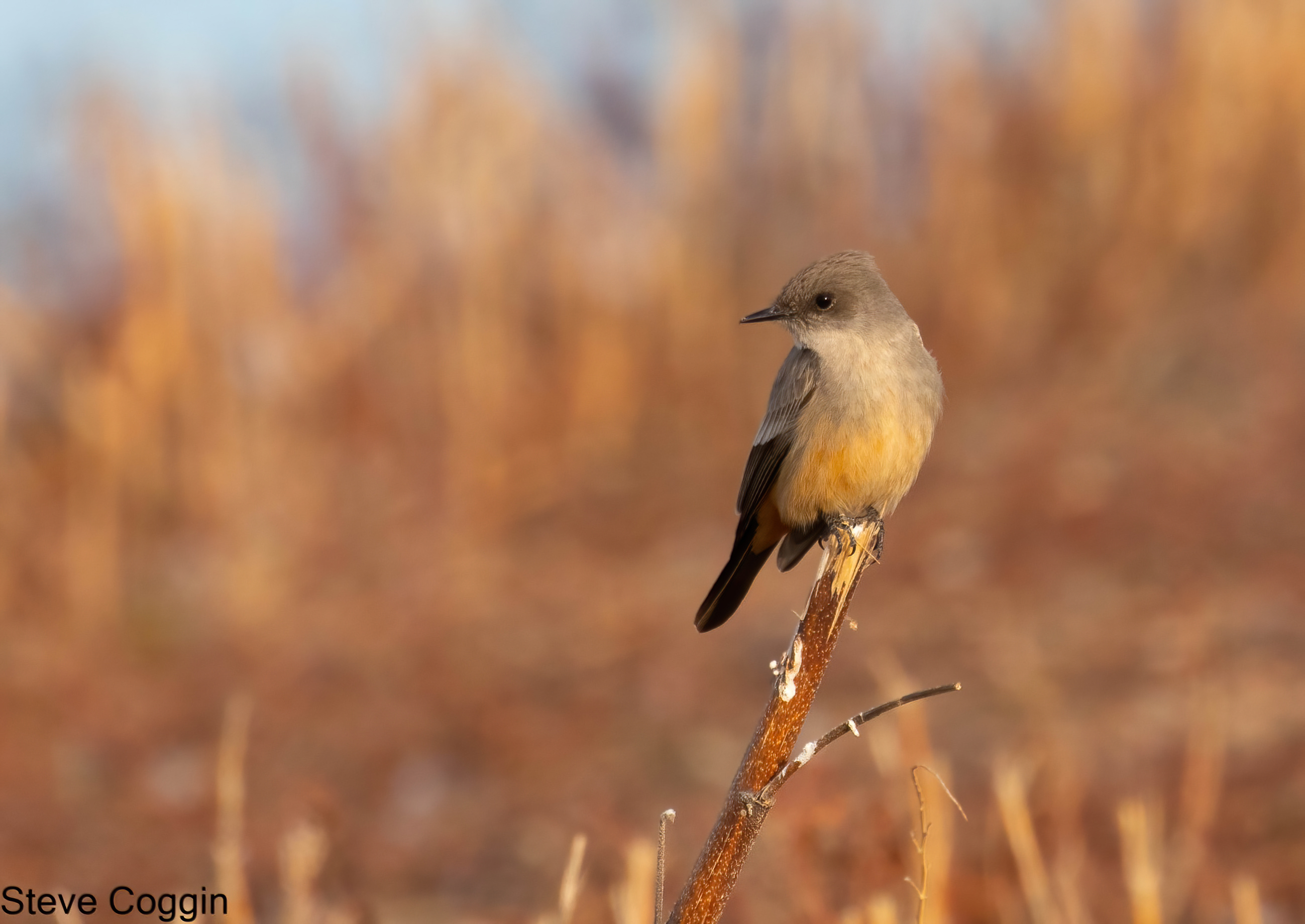
There are many land birds in the bosque too.  Coveys of Gambel’s Quail (Callipepla gambelii) with their jaunty topknots and rufous caps scamper through the brush giving their plaintive calls.  Overhead, flycatchers like the subdued Says Phobe (Sayornis saya) and the dazzling Vermillion Flycatcher (Pyrocephalus obscurus) snap up insects on the wing. 


Gambel's Quail (Callipepla gambelii).
Bosque del Apache National Wildlife Refuge, New Mexico. 

Say's Phoebe (Sayornis saya).
Bosque del Apache National Wildlife Refuge, New Mexico. 


Male Vermillion Flycatcher (Pyrocephalus obscurus).
Pecha Dam State Park, New Mexico.  

Three different species of bluebirds live in the bosque.  The most impressive is the bluest of the bluebirds, the Mountain Bluebird (Sialia currucoides).  The males of this lovely species are turquoise on the head and back, sky blue on the breast and fade to light blue on the belly. 


Male Mountain Bluebird (Sialia currucoides). 
Bernardo Wildlife Management Area, New Mexico.  

Blackbirds (Family Icteridae) are well represented in the bosque.  Western Meadowlarks (Sturnella neglecta) can be found singing, even in winter.  Brewer’s Blackbirds, (Euphagus cyanocephalus) gather in large flocks to feed in fields and perch in the tops of trees.  Male Brewer’s Blackbirds are iridescent black with yellow eyes and the females are brown with dark eyes.  We also found a single Yellow-headed Blackbird (Xanthocephalus xanthocephalus).  With its black body, bold white wing patches and bright yellow head, the Yellow-headed Blackbird stands out among the other blackbirds.  


Western Meadowlark (Sturnella neglecta) singing to the sunrise.
Mesilla Valley Bosque Wildlife Refuge, New Mexico. 

Male Brewer's Blackbird (Euphagus cyanocephalus).
Bosque del Apache National Wildlife Refuge, New Mexico. 

Female Brewer's Blackbird.
Bosque del Apache National Wildlife Refuge, New Mexico. 

Male Yellow-headed Blackbird (Xanthocephalus xanthocephalus). 
Bosque del Apache National Wildlife Refuge, New Mexico. 

The bosque was once a continuous forest following the Rio Grande through New Mexico.  The same environmental conditions that make this area so biologically rich; fertile soil, mild climate and a steady water supply, have also made it desirable to people.  Large swaths of the bosque have been converted to agriculture, the river has been channelized and irrigation systems put into place.  Cities, large and small, have grown up on the bosque, but natural areas remain that give us a glimpse of this unique ecosystem. 


Bosque with hot air balloon.
Albuquerque, New Mexico

 Thanks to Dr. Richard Pockat for providing excellent photographs for this blog.